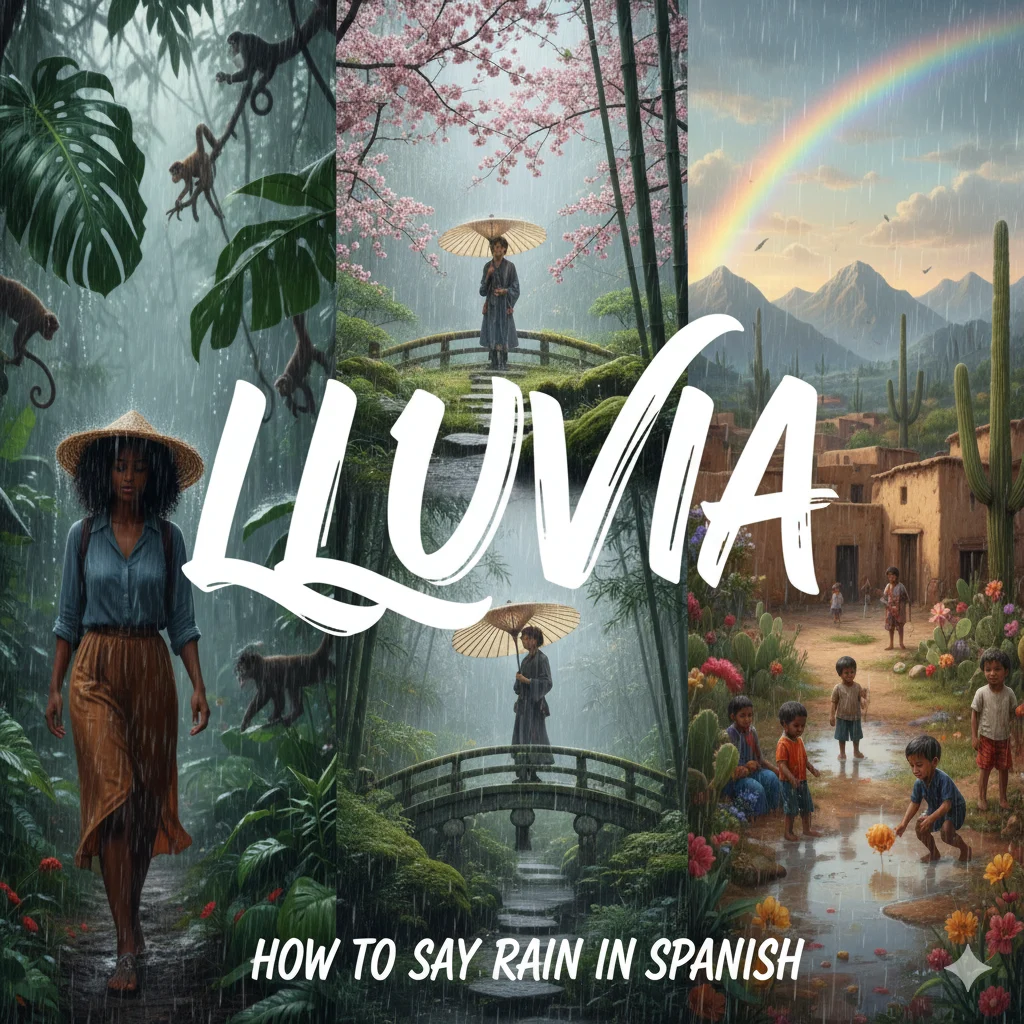
There’s something magical about rain. It can bring life to the earth, memories to our hearts, and calm to our souls.
The first time I heard the word “lluvia” while walking through the cobblestone streets of Madrid, it felt like poetry — soft and rhythmic, just like the rain itself. Locals smiled and said, “Me encanta la lluvia” — “I love the rain.”
That day, I realized that rain is more than a weather phenomenon — it’s a shared human experience. Across the world, every language has its own word for rain, each carrying stories of hope, renewal, and reflection.
Let’s journey through cultures and languages to understand how we express this simple yet powerful word.
🌍 Table of “Rain” in Different Languages
| Language | Word for “Rain” | Cultural or Linguistic Insight |
|---|---|---|
| Spanish | Lluvia | Soft and lyrical; symbolizes romance and renewal. |
| English | Rain | A neutral term often linked to mood and poetry. |
| French | Pluie | Associated with beauty and nostalgia in French art. |
| Italian | Pioggia | Romantic and musical, used in songs and literature. |
| German | Regen | Rooted in Old High German, symbolizing cleansing. |
| Portuguese | Chuva | Soft-sounding word tied to tropical climate and joy. |
| Turkish | Yağmur | A popular poetic word often used as a girl’s name. |
| Arabic | Matar (مطر) | Seen as a blessing — a gift from God. |
| Hindi | Baarish (बारिश) | Romantic and deeply emotional, central to Bollywood. |
| Japanese | Ame (雨) | Reflects tranquility and introspection in haiku. |
| Mandarin (Chinese) | Yǔ (雨) | Represents balance and natural cycles in Chinese philosophy. |
| Swahili | Mvua | Symbolizes fertility and renewal in East Africa. |
| Zulu | Imvula | Tied to abundance and agricultural blessings. |
| Hawaiian | Ua | Linked to life and spiritual energy in island culture. |
| Maori | Ua | Same as Hawaiian — reflects shared Polynesian roots. |
🇪🇸 How Do You Say Rain in Spanish?
In Spanish, the word for rain is “lluvia” (pronounced yoo-vee-ah).
Spanish, a language known for its melody and passion, gives even weather a soulful tone. “Lluvia” comes from the Latin pluvia, meaning “precipitation.” But beyond the dictionary, it represents emotion — love, reflection, and rebirth.
🌦️ Cultural Insight:
In Spain and Latin America, rain is often romanticized. Spanish literature and songs use lluvia as a metaphor for longing and cleansing. When someone says “Me gusta la lluvia” (I like the rain), it often implies peace and introspection, not just weather preference.
So, when you learn how to say rain in Spanish, you’re also learning how Spanish speakers feel it — with heart, poetry, and depth.
🇪🇺 Rain in European Languages: Emotion and Art
Europe’s diverse languages all give rain a special place in daily life and art.
- French — Pluie: Frequently used in romantic poetry and songs like “Sous la Pluie” (Under the Rain).
- Italian — Pioggia: Evokes love and nostalgia; “La pioggia” is a common theme in Italian music.
- German — Regen: Solid and straightforward, yet used in folklore to symbolize new beginnings.
- Portuguese — Chuva: Reflects joy; Brazilians celebrate summer rain as refreshing, not gloomy.
- Turkish — Yağmur: Means both rain and blessing; also a popular female name meaning purity.
In Europe, rain isn’t just weather — it’s art, memory, and mood.
🌏 Rain in Asian Languages: Blessing and Renewal
Asia’s cultures often view rain as a divine or life-giving force.
- Hindi (India) — Baarish: Central to romance and monsoon festivals; “Baarish” songs are iconic in Bollywood.
- Arabic — Matar (مطر): Rain is considered a sacred blessing — a mercy from the heavens.
- Chinese — Yǔ (雨): Symbolizes balance in nature; used in proverbs about patience.
- Japanese — Ame (雨): Found in haiku poetry; reflects silence, reflection, and beauty.
- Korean — Bi (비): Represents nostalgia and love in Korean dramas and music.
- Indonesian — Hujan: Tied to tropical rhythm; locals find comfort in its sound.
- Thai — Fon tok: Literally “the rain falls”; common in everyday speech.
- Filipino (Tagalog) — Ulan: Connected to renewal and emotional expression.
Across Asia, rain nourishes both the land and the soul — a symbol of growth and gratitude.
🌍 Rain in African Languages: Life, Growth, and Gratitude
In many African cultures, rain is celebrated — it’s not a disturbance but a divine blessing.
- Swahili — Mvua: Represents renewal and fertility; people often celebrate its arrival.
- Zulu — Imvula: Symbol of prosperity and new beginnings.
- Hausa — Ruwa: Also means “water”; essential for life and purity.
- Yoruba — Òjò: Has spiritual significance, often associated with the sky god.
- Amharic — Zena: Means “news,” but contextually refers to refreshing rains.
- Shona — Mvura: Central to traditional rainmaking ceremonies.
- Lingala — Mbula: Refers to both rain and seasonal blessings.
In African languages, rain is more than weather — it’s hope itself.
🌺 Rain in Indigenous & Island Languages: Spirit and Connection
From island cultures to native communities, rain symbolizes life, renewal, and connection with nature.
- Hawaiian — Ua: Seen as sacred, representing the breath of the gods.
- Maori — Ua: Same Polynesian root; a sign of spiritual connection.
- Samoan — Timuga: Symbolizes cleansing and emotional release.
- Cherokee — Ama: Means both “water” and “rain,” reflecting harmony with earth.
- Tahitian — Ua: Used in chants and prayers about growth and balance.
- Inuit — Uqaq: Represents survival and transformation in Arctic conditions.
- Fijian — Uca: Associated with joy, abundance, and community.
For indigenous peoples, rain is sacred — a reminder of humanity’s bond with nature.
💬 Cultural Insights: The Poetry of Rain
Rain has shaped stories, songs, and spirituality for millennia.
In Spanish, lluvia echoes through romantic ballads; in Arabic, matar blesses the land; in Africa, rain is joy; in Japan, it’s reflection.
No matter the language, rain represents the same truth: after every storm, life begins again.
🌧️ Proverbs About Rain Across Cultures
- Spanish: “Después de la lluvia, sale el sol.” — “After the rain, the sun comes out.”
- Japanese: “Ame futte ji katamaru.” — “After the rain, the ground hardens.” (Adversity strengthens.)
- Swahili: “Mvua ya kwanza ni baraka.” — “The first rain is a blessing.”
- Arabic: “After patience comes the rain.”
- English: “Into each life some rain must fall.”
Each proverb reminds us that rain, like challenges, leads to growth.
❓ FAQs
Q1: How do you say rain in Spanish?
In Spanish, rain is “lluvia.” It’s used in both literal and poetic contexts.
Q2: How do you pronounce “lluvia”?
It’s pronounced yoo-vee-ah, with a soft “y” sound.
Q3: What does “lluvia” symbolize in Spanish culture?
It symbolizes renewal, cleansing, and romance — common themes in Spanish art and literature.
Q4: What are other weather-related Spanish words?
“Sol” (sun), “nieve” (snow), “viento” (wind), and “tormenta” (storm).
Q5: What is the origin of the word “lluvia”?
It comes from the Latin pluvia, meaning rain or precipitation.
❤️ Conclusion: Lluvia — The Song of the Earth
Whether you call it lluvia, rain, ame, or matar, it’s more than water — it’s emotion, renewal, and connection.
It’s the same word that poets use to describe sadness, hope, or love.
So the next time the rain falls, listen closely — it’s the sound of the world speaking the same language.
💬 Now it’s your turn!
How do you say rain in your language? Share it in the comments below — let’s create a global rain of words and meanings. 🌦️