Have you ever been solving a math problem and saw the word “product” and thought, “Wait… what does that even mean?” Whether you’re a student, parent helping with homework, or just brushing up on basic math skills, understanding terms like product is essential.
Many learners search “what does the product mean in math” because they want a clear, simple explanation — without confusing jargon.
Quick Answer:
In math, the product is the result of multiplying two or more numbers together. It’s a straightforward way of saying, “this is what you get when you multiply.”
🧠 What Does Product Mean in Math?
The product is the outcome you get when you multiply numbers.
Example:
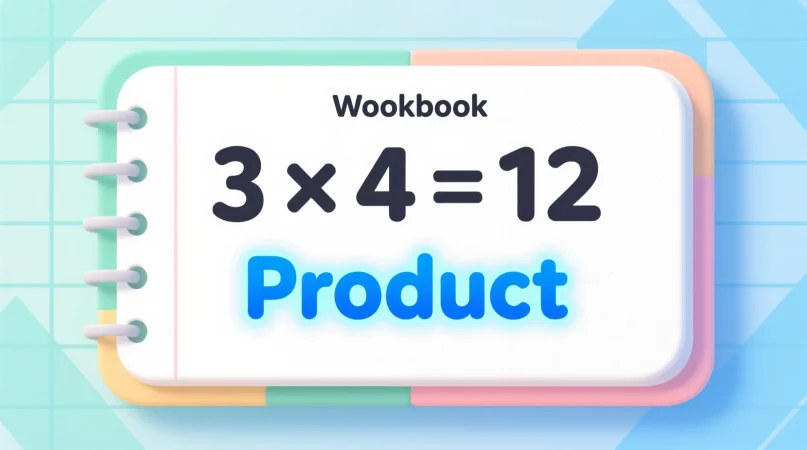
3×4=123 \times 4 = 123×4=12 → Here, 12 is the product.
It doesn’t matter if you multiply whole numbers, decimals, or fractions — the answer is always called the product.
In short:
Product = Result of multiplication = The answer you get when multiplying numbers.
📱 Where Is the Term Product Commonly Used?
- 🏫 Classroom math lessons — multiplication, area, volume
- 📚 Textbooks and worksheets — exercises use “product” in problems
- 🖥️ Online math tutorials and videos
- 💻 Homework and tests — elementary to advanced levels
Tone:
- Educational, clear, and formal enough for academic use
- Easy to understand for learners of all ages
💬 Examples of “Product” in Conversation
1
A: “What’s the product of 5 and 7?”
B: “It’s 35.”
2
A: “Can you explain product again?”
B: “Sure! Multiply the numbers — the answer is the product.”
3
A: “What’s the product of 0.5 and 6?”
B: “3 — that’s the product.”
4
A: “Are fractions included when finding a product?”
B: “Yes! Multiply the numbers, and the answer is the product.”
5
A: “Why do teachers call it a product?”
B: “It’s the standard term for a multiplication result.”
🕓 When to Use and When NOT to Use “Product”
✅ When to Use
- Solving multiplication problems
- Calculating area, volume, or algebraic expressions
- Explaining math concepts to students
- Academic homework, tests, or online tutorials
❌ When NOT to Use
- Addition or subtraction operations
- Scientific or non-math contexts where “result” is enough
- Casual conversation outside math
- When clarity requires “answer” instead of “product”
⭐ Comparison Table
| Context | Example Phrase | Why It Works |
|---|---|---|
| Math Class | “The product of 6 and 8 is 48.” | Educational, precise |
| Homework | “Find the product of fractions.” | Instructional |
| Word Problem | “Calculate the product of price and quantity.” | Practical usage |
| Textbook | “The product of x and y equals xy.” | Formal academic |
🔄 Similar Math Terms or Alternatives
| Term | Meaning | When to Use |
|---|---|---|
| Sum | Result of addition | Use in addition problems |
| Difference | Result of subtraction | Use in subtraction problems |
| Quotient | Result of division | Use in division problems |
| Factor | Number multiplied to get a product | When analyzing multiplication |
| Multiple | Numbers obtained by multiplying a number by an integer | For sequences and tables |
❓ FAQs
1. Is product only for whole numbers?
No, it can be decimals, fractions, or negative numbers too.
2. How is a product different from a sum?
A sum is the result of adding, while a product is the result of multiplying.
3. Can variables have a product?
Yes! x×y=xyx \times y = xyx×y=xy, and xy is the product.
4. Is product used in real life?
Yes — calculating area, volume, prices, or any multiplication situation.
5. How do you find the product in algebra?
Multiply the coefficients and variables; the result is the product.
6. Can the product be zero?
Yes! If any number multiplied is 0, the product is 0.
🧩 Mini Quiz – Test Your Knowledge
1. What does “product” mean in math?
A) Result of addition
✔️ B) Result of multiplication
C) Result of subtraction
2. What is the product of 4 × 5?
A) 9
✔️ B) 20
C) 12
3. Which is NOT a product?
✔️ A) 7 + 3
B) 7 × 3
C) xy
4. Can a product be zero?
✔️ A) Yes
B) No
C) Only if positive numbers
📝 Conclusion
In math, the product is simply the result of multiplying numbers together.
Whether you’re dealing with whole numbers, fractions, decimals, or algebraic expressions, the product tells you the answer.
Understanding this term helps with homework, tests, and real-life calculations like finding area, volume, or total costs. Once you know what a product is, you’ll be confident multiplying anything!