Have you ever opened a biology book, seen the word “eukaryotic,” and thought… wait, what?
You’re not alone. I remember seeing it for the first time in school and assuming it was some kind of futuristic robot species. But no — it’s actually a super important biology term that explains how living things are built.
If you’ve wondered what does eukaryotic mean, you’re in the right place. Let’s break it down in a simple, friendly way.
Quick Answer:
“Eukaryotic” refers to cells that have a nucleus and membrane-bound organelles.
In simple terms: eukaryotic = complex cells found in plants, animals, fungi, and humans.
🧠 What Does Eukaryotic Mean in Biology?
The term “eukaryotic” comes from Greek:
- “eu” = true
- “karyon” = nucleus
So, it literally means “true nucleus.”
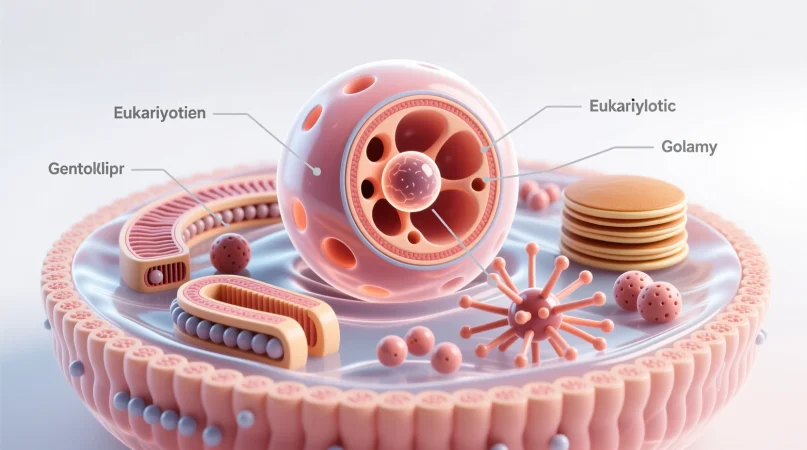
A eukaryotic cell is a complex cell that contains:
- a nucleus (its “control center”)
- organelles like mitochondria, Golgi bodies, ER, etc.
- linear DNA
⭐ Example Sentence:
“The cells of humans, animals, and plants are eukaryotic because they contain a nucleus.”
In short:
Eukaryotic = cell with a nucleus = complex organism.
📱 Where Is the Term “Eukaryotic” Commonly Used?
You’ll see or hear the term mostly in:
- 🧪 Biology classes
- 📘 Textbooks
- 🧬 Scientific research
- 🎓 College lectures
- 🌱 Plant and animal biology discussions
It’s an academic/scientific term — not used casually in daily conversation.
💬 Examples of “Eukaryotic” in Real Context
Here are some simple examples:
A: What type of cells do humans have?
B: We have eukaryotic cells.
A: Are mushrooms eukaryotic?
B: Yes, fungi are eukaryotic organisms.
A: What’s the difference between eukaryotic and prokaryotic cells?
B: Eukaryotic cells have a nucleus; prokaryotic cells don’t.
A: Is yeast eukaryotic?
B: Yep! It belongs to the fungi group.
A: Are plants eukaryotic?
B: Yes, all plant cells are eukaryotic.
A: So bacteria aren’t eukaryotic?
B: Correct — bacteria are prokaryotic.
🕓 When to Use and NOT Use “Eukaryotic”
✅ Use “Eukaryotic” When:
- Explaining biology
- Discussing cell types
- Comparing cell structures
- Writing academic content
- Describing organisms with nuclei
❌ Do NOT Use “Eukaryotic” When:
- Talking casually
- Describing bacteria (they are NOT eukaryotic)
- Explaining non-biological topics
- Talking about viruses (they aren’t cells at all!)
📊 Comparison Table
| Context | Example Phrase | Why It Works |
|---|---|---|
| Classroom | “Plants have eukaryotic cells.” | Accurate and educational |
| Research | “Eukaryotic organisms contain membrane-bound organelles.” | Scientifically correct |
| Casual Chat | “Humans have complex cells.” | More natural |
| Kids’ Explanation | “Our cells have a little ‘control center’ inside.” | Simplified |
🔄 Similar Terms You Should Know
| Term | Meaning | When to Use |
|---|---|---|
| Prokaryotic | Cells without a nucleus | When talking about bacteria |
| Organelle | Structures inside a cell | When explaining cell parts |
| Nucleus | The cell’s control center | When describing DNA location |
| Cytoplasm | Jelly-like fluid in cells | When explaining cell structure |
| Mitochondria | Cell’s energy factory | When teaching cell functions |
| Chromosomes | DNA structures | When discussing genetics |
❓ FAQs
1. Does eukaryotic mean complex?
Yes — eukaryotic cells are considered complex cells.
2. Are humans eukaryotic?
Absolutely. All human cells are eukaryotic.
3. Are plants eukaryotic?
Yes, plants are fully eukaryotic organisms.
4. Are bacteria eukaryotic?
No — bacteria are prokaryotic.
5. Do eukaryotic cells have DNA?
Yes. Their DNA is stored inside the nucleus.
📝 Mini Quiz – Test Your Knowledge
1. What does “eukaryotic” mean?
a) No nucleus
b) True nucleus ✅
c) No DNA
2. Which organisms are eukaryotic?
a) Bacteria
b) Animals, plants, fungi ✅
c) Viruses
3. What type of DNA do eukaryotes have?
a) Circular
b) Linear ✅
c) None
4. Which cells have mitochondria?
a) Eukaryotic cells ✅
b) Prokaryotic cells
5. Are fungi eukaryotic?
a) No
b) Yes ✅
🔚 Conclusion
Understanding what eukaryotic means is the first step to understanding biology at a deeper level.
Whenever you hear “eukaryotic,” just remember:
👉 It refers to complex cells that have a nucleus — like the ones in plants, animals, fungi, and YOU.
Simple, right?