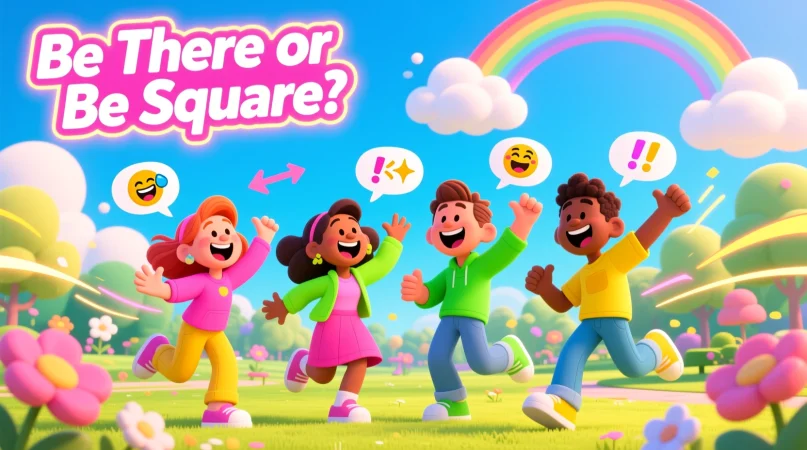
If someone ever texted you “Be there or be square!” and you paused wondering… Square? Am I supposed to bring something? Why square?? — you’re not alone. I remember seeing this phrase for the first time in a group chat and thinking it was some kind of weird geometry joke.
Whether you’re a student, a social media user, or someone trying to understand English expressions, you’ve probably searched “What does be there or be square mean” for a quick, simple explanation.
Quick Answer:
“Be there or be square” means “You should come — don’t miss out!”
It’s a fun, playful, and slightly teasing way of inviting someone.
🧠 What Does “Be There or Be Square” Mean in Text?
The phrase “be there or be square” is a humorous expression meaning:
- Don’t miss the event
- You should definitely come
- If you don’t come, you’re “uncool” (playfully)
- Get involved, join the fun
The “square” part comes from the old slang meaning “boring” or “uncool.”
Example sentence:
“Party at 8! Be there or be square 😄”
In short:
Be there or be square = Don’t miss it = Join the fun.
📱 Where Is “Be There or Be Square” Commonly Used?
You’ll see this phrase in fun, informal, friendly conversations, especially on:
- 📱 Text messages
- 📸 Instagram stories
- 😄 Group chats
- 🎮 Gaming chats
- 💬 Snapchat
- 🎥 TikTok captions
Tone:
- ✔️ Casual
- ✔️ Playful
- ✔️ Friendly teasing
- ❌ Not formal
💬 Examples of “Be There or Be Square” in Conversation
1
A: “We’re meeting at 7!”
B: “Be there or be square!”
2
A: “Movie night tonight?”
B: “Yep! Be there or be square 🎬”
3
A: “Should I come to the meetup?”
B: “Of course! Be there or be square 😄”
4
A: “Don’t forget my birthday dinner.”
B: “I’ll be there — I refuse to be square 😂”
5
A: “Game night tomorrow!”
B: “Be there or be square 🎮”
6
A: “Are you coming to the gym session?”
B: “Be there or be square 💪”
🕓 When to Use and When NOT to Use “Be There or Be Square”
✅ Use It When:
- Inviting friends casually
- Planning a fun event
- Encouraging someone to join
- Wanting to sound playful or funny
- Messaging someone close to you
❌ Don’t Use It When:
- Sending a formal invitation
- Writing an email to coworkers
- Messaging your boss
- Talking about serious events
- Inviting someone who might misunderstand jokes
⭐ Comparison Table
| Context | Example Phrase | Why It Works |
|---|---|---|
| Friend Chat | “Be there or be square 😄” | Fun & casual |
| Work Chat | “Please attend the meeting.” | Professional |
| “You’re invited to join us.” | Formal & clear | |
| Group Chat | “Party tonight — be there!” | Friendly & social |
🔄 Similar Slang or Alternatives
| Slang | Meaning | When to Use |
|---|---|---|
| Don’t miss out | Come or you’ll regret it | Neutral tone |
| Pull up | Come here / join | Very casual |
| Slide through | Stop by | Friendly & chill |
| Show up | Attend the event | Basic & universal |
| Come thru | Join in | Urban/casual vibe |
❓ FAQs
1. Is “be there or be square” an insult?
No — it’s playful, not rude.
2. Is it formal or casual?
Very casual.
3. Where did “square” come from?
Old slang meaning “boring” or “not cool.”
4. Can you use it in text messages?
Yes — it’s very common.
5. Is it still popular today?
Yes, mostly among teens and young adults.
6. Is it used worldwide?
Mostly in English-speaking countries.
🧩 Mini Quiz – Test Your Knowledge
1. What does “be there or be square” mean?
✔️ A) Don’t miss the event
B) Bring a square object
C) Be serious only
2. Is the phrase formal or casual?
✔️ A) Casual
B) Formal
C) Business-friendly
3. What does “square” mean in this phrase?
A) A shape
✔️ B) Uncool / Boring
C) A location
📝 Conclusion
“Be there or be square” is a fun, lighthearted way to invite someone and encourage them not to miss out. It’s friendly, playful, and perfect for casual conversations with people you know well. Whether you see it in texts, captions, or group chats, now you know — it simply means “Come join us!”
Use it to add personality and humor to your messages, but avoid it in formal or serious situations.