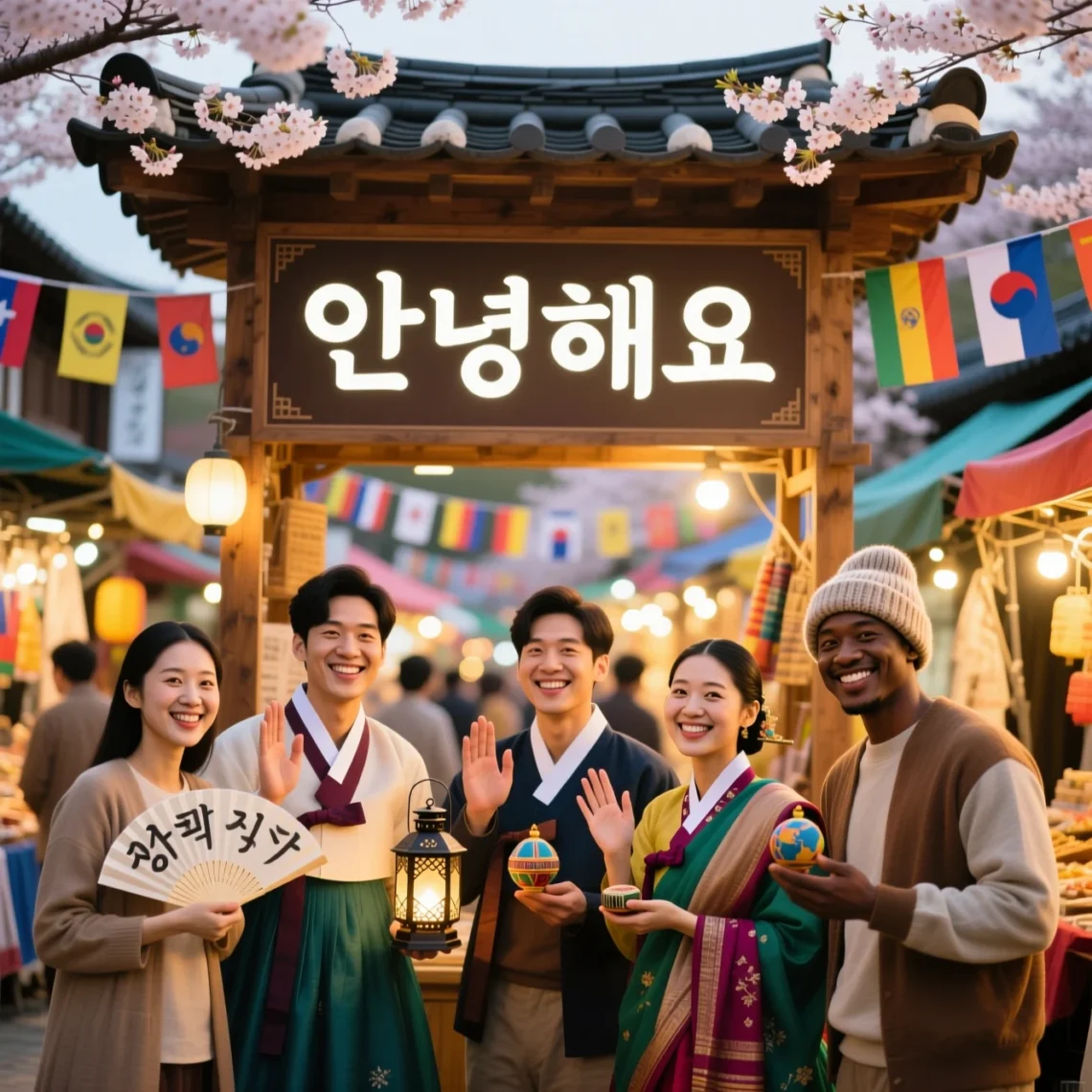
The first time I heard someone say “Annyeonghaseyo”, I was struck by how graceful it sounded — soft, melodic, and polite. I was in Seoul, watching two shopkeepers greet each other with a slight bow and that word that seemed to float between them like a gesture of kindness.
That’s when I realized: a simple “hi” isn’t just a word — it’s a window into a culture’s heart.
Learning how to say hi in Korean opens a door to understanding not only language, but also the deep value of respect that shapes Korean society. And when we look at how different cultures greet one another, we see the same beautiful truth — that humanity, in all its diversity, shares one universal desire: to connect.
🗺️ Table of Greetings Around the World
| Language | Word/Phrase for “Hi” | Cultural Insight |
|---|---|---|
| Korean | Annyeonghaseyo (안녕하세요) | Means “are you at peace?”; conveys respect and care. |
| Turkish | Merhaba | Universal greeting symbolizing openness and friendship. |
| English | Hi / Hello | Friendly and casual, often said with a smile or wave. |
| French | Bonjour | A courteous “good day” that’s essential in polite interaction. |
| Spanish | Hola | Warm and expressive; often used with cheek kisses. |
| Italian | Ciao | Both “hello” and “goodbye,” reflecting informality. |
| German | Hallo / Guten Tag | Shows balance between formality and friendliness. |
| Japanese | Konnichiwa | Literally “good afternoon”; part of daily etiquette. |
| Arabic | As-salamu alaykum | “Peace be upon you”; deeply spiritual and respectful. |
| Mandarin (Chinese) | Nǐ hǎo (你好) | Means “you good,” focusing on mutual well-being. |
| Hindi (India) | Namaste (नमस्ते) | “I bow to you”; a gesture of humility and respect. |
| Swahili | Jambo / Habari | Friendly and conversational greetings. |
| Zulu | Sawubona | Means “I see you”; acknowledges one’s humanity. |
| Hawaiian | Aloha | Symbol of love, peace, and connection. |
| Maori | Kia ora | “Be well”; expresses gratitude and friendship. |
🇰🇷 How to Say Hi in Korean
The Korean phrase for “hi” or “hello” is Annyeonghaseyo (안녕하세요) — pronounced ahn-nyoung-ha-se-yo.
It’s used in almost every social setting, whether greeting a stranger, a colleague, or even a teacher. The literal meaning is “are you at peace?” — showing how deeply Korean language values harmony and well-being.
For close friends or informal settings, Koreans say “Annyeong” (안녕) — a shorter, friendly version of the greeting.
Cultural Insight:
When saying Annyeonghaseyo, it’s customary to bow slightly. The depth of your bow shows respect: a small nod for casual interactions, a deeper bow for elders or superiors.
Learning how to say hi in Korean isn’t just about pronunciation — it’s about understanding a culture that honors respect and balance in every human connection.
🇪🇺 How to Say Hi in European Languages
Europe’s greetings range from formal politeness to casual friendliness, depending on region and culture.
- France — Bonjour: Always start conversations with it; it’s a sign of respect.
- Spain — Hola: Accompanied by hugs or cheek kisses, reflecting warmth.
- Italy — Ciao: Light-hearted, showing intimacy and friendliness.
- Germany — Hallo / Guten Tag: Combines precision with politeness.
- Greece — Yasou: “To your health,” a blessing as much as a greeting.
- Portugal — Olá: Cheerful and melodious, easy to use in all situations.
European greetings emphasize social etiquette and acknowledgment — whether you’re in a Parisian café or a small Italian village, a greeting is the start of connection.
🌏 How to Say Hi in Asian Languages
Asia’s languages reflect its diversity — from spiritual reverence to joyful hospitality.
- Korea — Annyeonghaseyo: “Are you at peace?” — respect in sound and form.
- Japan — Konnichiwa: A blend of politeness and humility, often said with a bow.
- China — Nǐ hǎo: Mutual respect and balance in every exchange.
- India — Namaste: Recognizes the divine in each person.
- Thailand — Sawasdee ka/krub: Polite, soft, and always accompanied by a “wai” (palms pressed together).
- Vietnam — Xin chào: Melodic and warm, reflecting hospitality.
- Philippines — Kumusta: Friendly, borrowed from Spanish yet uniquely Filipino.
- Turkey — Merhaba: Peaceful and welcoming, rooted in Ottoman history.
- Indonesia — Halo: A simple yet friendly greeting with universal appeal.
- Arabic world — As-salamu alaykum: One of the oldest greetings still used globally.
In Asia, every greeting carries a wish — for peace, respect, or harmony — and that’s what makes them so powerful.
🌍 How to Say Hi in African Languages
African greetings often go beyond words — they include gestures, time, and sincere interest.
- Swahili — Jambo / Habari: Invites conversation and genuine connection.
- Zulu — Sawubona: “I see you”; greeting as recognition.
- Yoruba — Bawo ni? “How are you?” — a sign of care and inquiry.
- Amharic — Selam: Derived from “peace”; used across Ethiopia.
- Hausa — Sannu: Friendly and versatile.
- Akan (Ghana) — Maakye: “Good morning”; greetings change with time of day.
- Somali — Iska warran? “What’s the news?”; shows community interest.
- Lingala — Mbote: Joyful and expressive.
- Berber — Azul: Ancient greeting symbolizing peace.
- Shona — Mhoro: Simple but warm.
In Africa, to greet is to connect — it’s how communities strengthen relationships daily.
🌺 How to Say Hi in Indigenous & Island Languages
Island and Indigenous greetings are rooted in harmony — with people and nature alike.
- Hawaiian — Aloha: “Love,” “peace,” and “hello”; a complete philosophy of life.
- Maori — Kia ora: Means “be well,” showing gratitude and positivity.
- Samoan — Talofa: “I’m happy to see you”; pure joy in words.
- Cherokee — Osiyo: A heartfelt welcome for all.
- Tahitian — Ia ora na: “May you live”; poetic and life-affirming.
- Fijian — Bula: Means “life” — said with wide smiles.
- Inuit — Aluu: Genuine and simple.
- Haitian Creole — Bonjou: French-inspired but Caribbean in warmth.
- Tagalog — Kumusta: Friendly and familiar.
- Guaraní — Avy’a rohayhu: Expresses happiness at seeing someone.
These greetings carry spiritual undertones — reminding us that connection is sacred.
💬 Cultural Insights: The Philosophy of Greetings
The phrase “Annyeonghaseyo” captures Korea’s cultural core — harmony, humility, and social awareness.
Just like “Merhaba” in Turkish or “Aloha” in Hawaiian, greetings evolve from deeper cultural philosophies.
Historically, greetings began as peaceful gestures among tribes, traders, and travelers — an assurance of safety and goodwill. Today, whether said in person or online, they still hold that same emotional power.
A greeting is not just communication — it’s recognition of shared humanity.
🌸 Proverbs About Greeting Around the World
- Korean: “A kind word warms even in winter.”
- Turkish: “A smiling face is half the greeting.”
- Zulu: “I am because we are.”
- Japanese: “One kind word can warm three winter months.”
- Arabic: “Begin with peace, end with peace.”
- Italian: “Who greets first has more friends.”
Each proverb reminds us that how we greet determines how we connect.
❓ FAQs
Q1: How do you say hi in Korean?
You say “Annyeonghaseyo” (안녕하세요), pronounced ahn-nyoung-ha-se-yo.
Q2: What does Annyeonghaseyo mean?
It means “are you at peace?” — a reflection of Korea’s emphasis on respect and harmony.
Q3: Can I use Annyeonghaseyo with friends?
With close friends or younger people, use the informal version “Annyeong” (안녕).
Q4: Why do Koreans bow when greeting?
The bow symbolizes respect, gratitude, and humility — key pillars of Korean etiquette.
Q5: Are there other Korean greetings I should know?
Yes! “Anyoung” (안녕) for casual use, and “Annyeonghasimnikka” (안녕하십니까) for very formal situations.
❤️ Conclusion: A Greeting That Unites
Whether it’s Annyeonghaseyo in Seoul, Bonjour in Paris, or Aloha in Hawaii — every “hi” carries the same message: I see you, I respect you, and I’m glad you’re here.
Learning how to say hi in Korean is not just learning a phrase — it’s understanding a culture that values respect and emotional connection above all.
So next time you meet someone, take a breath, smile, and say Annyeonghaseyo — because kindness truly needs no translation.
💬 Now it’s your turn:
How do you say “hi” in your language? Share your greeting in the comments and join our global “Annyeonghaseyo” wave of peace! 🌍