It’s fascinating how a tiny word can hold such immense meaning. “I” — just one letter in English — represents everything about who we are: our thoughts, our emotions, our very existence.
When I first started learning Spanish, the word that truly made me feel fluent wasn’t a fancy verb or idiom — it was the simple, powerful “Yo.”
That one word suddenly gave me a new way to say I am here, I exist, I matter.
In Spanish, “Yo” doesn’t just translate to “I.” It expresses presence, emotion, and self-awareness. It’s used with verbs, identity statements, and everyday expressions — connecting your inner self to the world around you.
But how does this idea — the self — differ across languages and cultures? Let’s explore how the word “I” reveals something much deeper about humanity.
🗺️ Table of “I” Across the World
| Language | Word for “I” | Cultural or Linguistic Insight |
|---|---|---|
| Spanish | Yo | Represents the self; often dropped in speech because verb endings already imply “I.” |
| English | I | Always capitalized — symbolizing individual importance in English grammar. |
| French | Je | Flows naturally into verbs; shows connection between subject and action. |
| Italian | Io | Expressive and emotional, reflecting Italy’s rich linguistic melody. |
| German | Ich | Pronounced with a soft “h”; reflects precision and clarity in speech. |
| Portuguese | Eu | Often used softly; the “I” blends smoothly with verbs. |
| Turkish | Ben | Means “I”; reflects individuality balanced with community identity. |
| Arabic | Ana (أنا) | Deeply personal, often used in emotional or poetic expressions. |
| Hindi | Main (मैं) | Represents personal expression, often paired with respectful verb forms. |
| Japanese | Watashi / Boku / Ore | Multiple words depending on context, age, and gender — showing social nuance. |
| Swahili | Mimi | Emphasizes respect and community, balancing self with collective. |
| Korean | Na (나) | Informal form of “I,” used differently in hierarchical situations. |
| Russian | Ya (Я) | Strong personal identity; also used in expressions of emotion. |
| Greek | Ego (Εγώ) | Root of the English word “ego”; used both personally and philosophically. |
| Zulu | Mina | Means “I”; carries warmth and connection within community interactions. |
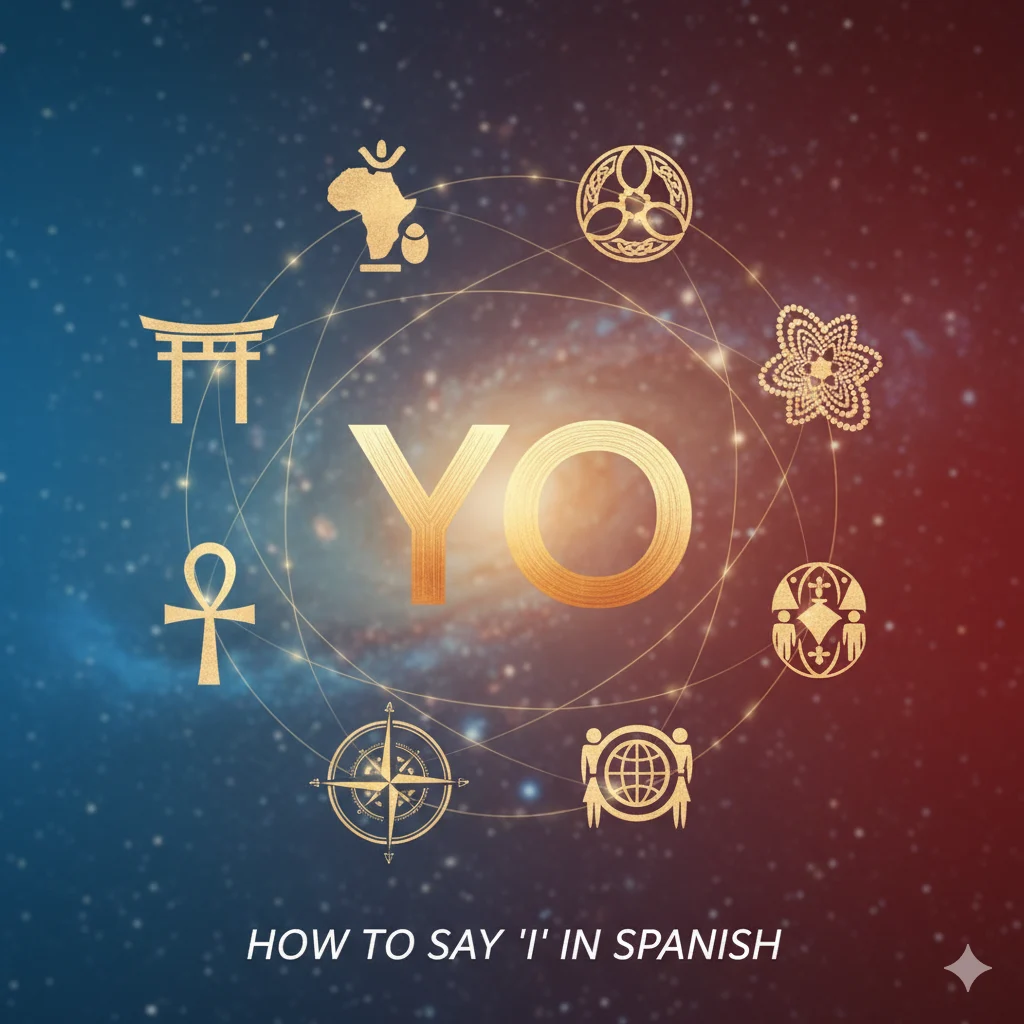
🇪🇸 How to Say “I” in Spanish
The word “I” in Spanish is “Yo” (pronounced yoh).
It’s the first-person singular pronoun, just like “I” in English. However, in Spanish, it’s often optional in sentences. For example:
- Yo hablo español → “I speak Spanish.”
- Hablo español → also means “I speak Spanish.”
Spanish verbs already carry the meaning of “I” through their endings, so native speakers often leave Yo out — unless they want to emphasize themselves:
- Yo lo hice. (“I did it.”)
- Yo te entiendo. (“I understand you.”)
Cultural Insight:
Spanish is a language of connection and emotion. The word “Yo” is rarely about ego — it’s about relationship, expression, and empathy. It reminds us that “I” doesn’t exist without “you.”
🇪🇺 “I” in European Languages
Europe’s languages have deep historical roots in Latin and Greek, shaping how people express identity.
- French — Je: Connects subject and verb in elegant flow: “Je suis” (I am).
- Italian — Io: Expressive and musical, it feels full of personality.
- German — Ich: Firm yet subtle, reflecting clarity and structure.
- Portuguese — Eu: Used softly, blending emotion and melody.
- Greek — Ego: Philosophically rich, linked to the origins of “ego” in psychology.
Each European “I” reveals a different cultural philosophy — from the individual pride of English “I” to the connected expressiveness of “Io.”
🌏 “I” in Asian Languages
Across Asia, self-expression is often shaped by community, respect, and harmony — and that’s reflected in language.
- Japanese — Watashi / Boku / Ore: Choice of word depends on gender, formality, and humility.
- Chinese — Wǒ (我): Balanced and simple; reflects harmony between self and society.
- Hindi — Main (मैं): Used naturally in daily life, often paired with polite verbs.
- Korean — Na (나): Used informally; formal version “Jeo (저)” shows respect.
- Arabic — Ana (أنا): Used widely across dialects; poetic and spiritual undertones.
- Thai — Chan / Phom: Gender-based differences in expressing “I.”
- Tagalog — Ako: Represents humility and emotional closeness.
- Vietnamese — Tôi: Often used politely, reflecting Confucian values of respect.
Asian languages show that “I” is never alone — it always lives within the context of we.
🌍 “I” in African Languages
In many African cultures, individuality is intertwined with community. The word for “I” often carries warmth and unity.
- Swahili — Mimi: Means “I,” but also used to express empathy or understanding.
- Zulu — Mina: Rooted in relationship — “I see myself through you.”
- Yoruba — Emi: Deeply personal yet respectful; language of connection.
- Hausa — Ni: Simple but expressive.
- Amharic — Ene: Soft and respectful, emphasizing humility.
- Shona — Ini: Warm and personal; often used in storytelling.
- Akan — Me: Direct translation of “I,” often followed by kinship expressions.
- Somali — Aniga: Means “I,” reflecting both individuality and togetherness.
- Igbo — M: Used in short phrases; symbolic of the speaker’s presence.
In African traditions, the “I” is seen not as isolation — but as part of the whole.
🌺 Indigenous & Island Languages: “I” and Identity
Indigenous and island languages often connect the self to nature, ancestors, and spirit.
- Hawaiian — Au: Used in phrases like “Aloha au ia ‘oe” (“I love you”).
- Maori — Ahau: Represents self and connection to community.
- Cherokee — Tsi: Tied to verbs; conveys belonging and presence.
- Samoan — O a‘u: “I am” — carries pride and love for identity.
- Inuit — Uvanga: Meaning “I myself,” expressing individuality within a collective.
- Tahitian — Vau: Used formally; poetic in structure.
- Fijian — Au: Represents personal truth and presence.
- Tagalog — Ako: Similar to Spanish “Yo,” symbolizing shared colonial roots.
- Māori (Polynesia) — Ahau: A reminder of the interconnectedness of all beings.
Here, “I” is not separate — it’s sacred, part of the circle of life and nature.
💬 Cultural Insights: The Story of “I”
From “Yo” in Spanish to “Watashi” in Japanese and “Ana” in Arabic, the concept of “I” has evolved to reflect how societies view individuality.
In the West, “I” represents independence. In the East, it signifies harmony. In Africa, it’s identity through community.
Language, then, is not just communication — it’s culture, emotion, and self-awareness.
🌸 Proverbs About “I” Across Cultures
- Spanish: “El yo sin el tú no existe.” — “The ‘I’ without the ‘you’ does not exist.”
- English: “No man is an island.”
- Japanese: “The nail that sticks out gets hammered down.” (Value of humility over ego.)
- African Proverb: “I am because we are.” — Ubuntu philosophy of shared humanity.
- Arabic: “He who knows himself knows his Lord.”
Each saying reminds us that understanding “I” begins with understanding others.
❓ FAQs
Q1: What is “I” in Spanish?
The word “I” in Spanish is Yo.
Q2: How do you pronounce “Yo”?
It’s pronounced yoh, with a soft “y.”
Q3: Do you always use “Yo” in Spanish sentences?
No. Since Spanish verbs include the subject in their endings, “Yo” is often omitted unless emphasizing the speaker.
Q4: Why is “I” capitalized in English but not in Spanish?
English capitalization evolved to emphasize the self, while Spanish maintains a more balanced grammatical structure.
Q5: What’s the deeper meaning of “Yo” in Spanish culture?
“Yo” symbolizes identity and emotion — not ego, but the self in connection with others.
❤️ Conclusion: Finding Yourself in Every “Yo”
Whether you say Yo, Je, Watashi, or Mimi, each version of “I” is a mirror — reflecting not only language but also culture, connection, and compassion.
Learning how to say “I” in Spanish is just the beginning. It’s a way to explore identity — how we express ourselves, and how we relate to others around the world.
💬 Now it’s your turn:
Say “I” in your language in the comments — and share what it means to you. Let’s build a global conversation about identity, expression, and understanding. 🌎