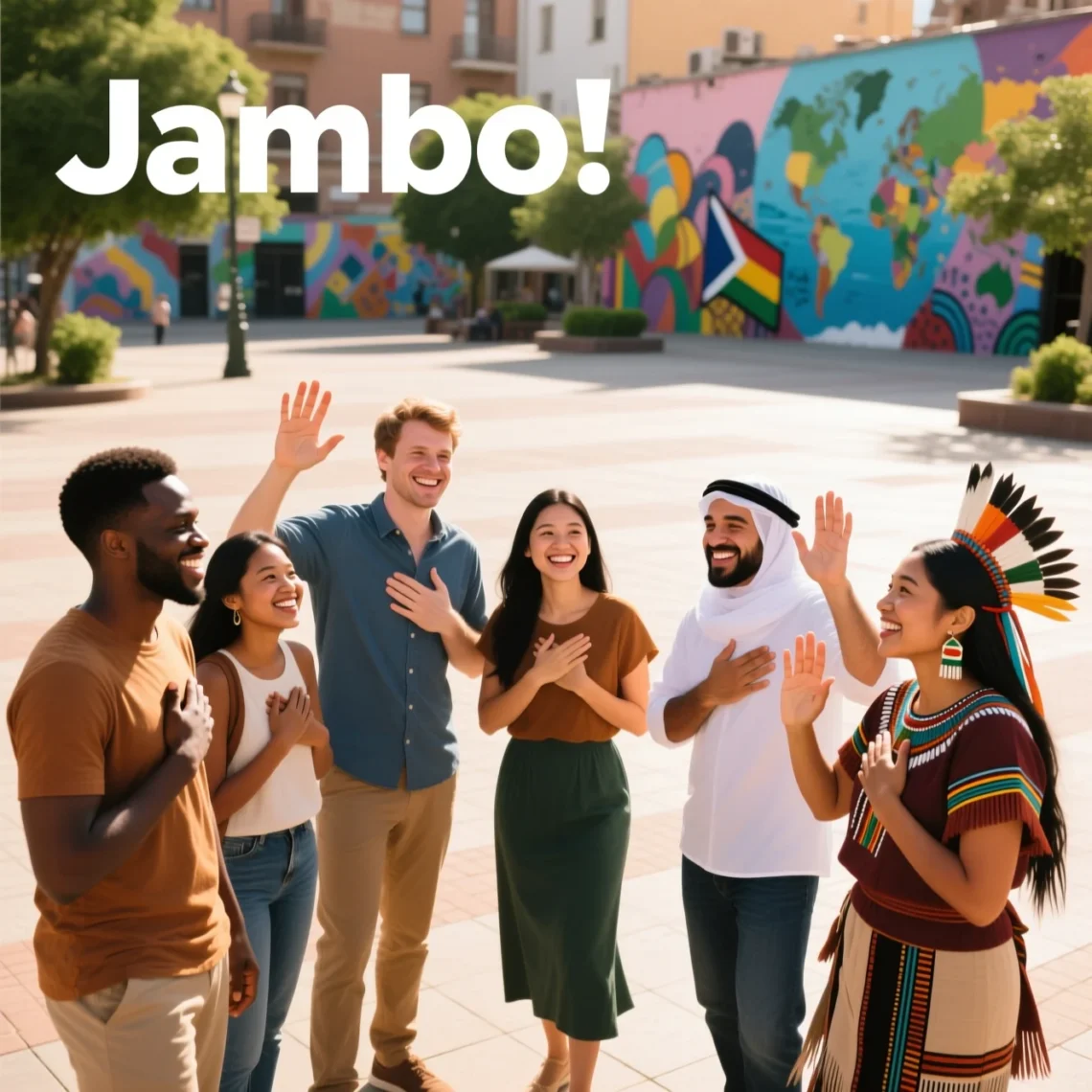
The first time I heard “Jambo”, I was standing in a bustling marketplace in Nairobi.
Vendors smiled as they waved, saying “Jambo, rafiki!” — “Hello, friend!”
It wasn’t just a word — it was music.
A melody of welcome, warmth, and belonging.
That’s when I realized: learning how to say hi in Swahili is more than learning a greeting. It’s understanding a people whose language embodies friendliness, openness, and community spirit.
And across the globe — from Japan to France, Turkey to Fiji — the simple act of saying “hi” has always been the first bridge between strangers.
Let’s explore how Swahili’s “Jambo” connects us to Africa — and the rest of the world.
🗺️ Table of Greetings Around the World
| Language | Word/Phrase for “Hi” | Cultural Insight |
|---|---|---|
| Swahili | Jambo | Friendly and universal; used widely across East Africa. |
| English | Hi / Hello | Simple and global; signifies friendliness and openness. |
| French | Bonjour | Literally “good day”; a daily gesture of respect. |
| Spanish | Hola | Warm and casual; often paired with hugs or cheek kisses. |
| Italian | Ciao | Informal greeting and farewell — lively and emotional. |
| German | Hallo / Guten Tag | Used based on formality; emphasizes clarity and order. |
| Arabic | As-salamu alaykum | “Peace be upon you”; a spiritual wish of peace. |
| Turkish | Merhaba | Symbolizes openness and connection; used everywhere. |
| Mandarin (Chinese) | Nǐ hǎo (你好) | “You good?” — expresses mutual respect. |
| Hindi (India) | Namaste (नमस्ते) | “I bow to you”; spiritually grounded in respect. |
| Zulu | Sawubona | “I see you”; deeply human and relational. |
| Hawaiian | Aloha | Embodies love, peace, and compassion. |
| Maori (New Zealand) | Kia ora | “Be well”; used for greetings and thanks alike. |
| Russian | Privet (Привет) | Friendly, informal greeting among peers. |
| Korean | Annyeonghaseyo | “Are you peaceful?”; respectful and polite. |
🇰🇪 How to Say Hi in Swahili
The Swahili word for “hi” is Jambo (pronounced jahm-bo).
It’s cheerful, inviting, and used across Kenya, Tanzania, Uganda, and much of East Africa.
You might also hear variations like:
- “Hujambo?” (How are you?)
- “Sijambo.” (I’m fine.)
- “Habari.” (What’s the news?)
Cultural Insight:
In Swahili culture, greetings are more than formality — they’re a social ritual. You don’t just say “hi” and move on. You ask about family, health, and life. It’s how people show care, respect, and community spirit.
Learning how to say hi in Swahili teaches you to slow down and connect — not just to communicate, but to relate.
🇪🇺 How to Say Hi in European Languages
In Europe, greetings are both expressions of etiquette and connection.
- France — Bonjour: Essential before any conversation; conveys civility.
- Spain — Hola: A warm, energetic hello — often followed by an embrace.
- Italy — Ciao: Informal and affectionate; both “hello” and “goodbye.”
- Germany — Hallo / Guten Tag: Practical, clear, and polite.
- Greece — Yasou: “To your health,” combining friendliness and good wishes.
- Netherlands — Hallo / Hoi: Casual and friendly, mirroring Dutch informality.
Europe’s greetings reveal how deeply social harmony is valued — every hello carries history and courtesy.
🌏 How to Say Hi in Asian Languages
Asia’s diversity shines in its greetings — each one steeped in cultural respect and spiritual meaning.
- China — Nǐ hǎo: “You good?”; polite and formal, emphasizing respect.
- Japan — Konnichiwa: Often said with a bow, reflecting discipline and humility.
- India — Namaste: “I bow to you”; a sacred gesture of reverence.
- Korea — Annyeonghaseyo: “Are you at peace?”; rooted in care and well-being.
- Thailand — Sawasdee ka/krub: Graceful and polite, paired with a bow (wai).
- Vietnam — Xin chào: Simple and welcoming.
- Turkey — Merhaba: Borrowed from Arabic “marhaban,” symbolizing peace.
- Indonesia — Halo: Friendly, modern, and influenced by global culture.
- Philippines — Kumusta: Derived from Spanish “cómo está,” showing historical blending.
- Arabic-speaking countries — As-salamu alaykum: “Peace be upon you,” a timeless greeting.
Across Asia, greetings are reflections of values — respect, balance, and human warmth.
🌍 How to Say Hi in African Languages
Africa’s languages are rich with expressions of friendship and unity.
- Swahili — Jambo / Habari: “Hello” or “How are things?”; conversation openers.
- Zulu — Sawubona: “I see you”; acknowledges one’s spirit.
- Yoruba — Bawo ni? “How are you?”; used with care and curiosity.
- Amharic — Selam: From “peace”; symbolizes spiritual calm.
- Hausa — Sannu: Used daily, full of warmth.
- Somali — Iska warran? “What’s the news?”; builds real connection.
- Shona — Mhoro: Simple but sincere.
- Akan (Ghana) — Maakye: “Good morning”; time-specific greetings matter.
- Lingala — Mbote: A lively, joyful hello.
- Berber — Azul: “Peace”; ancient and poetic.
Swahili stands out because it unites nations — from Kenya’s coast to Congo’s jungles, “Jambo” is understood as a symbol of East African identity.
🌺 How to Say Hi in Indigenous & Island Languages
Indigenous and island greetings reflect nature, spirituality, and unity.
- Hawaiian — Aloha: Means “love,” “peace,” and “hello.”
- Maori — Kia ora: “Be well”; a greeting of gratitude and connection.
- Samoan — Talofa: “I’m happy to see you.”
- Cherokee — Osiyo: Sign of warmth and openness.
- Tahitian — Ia ora na: “May you live.”
- Fijian — Bula: “Life” — said with big smiles.
- Inuit — Aluu: Friendly and practical for harsh climates.
- Haitian Creole — Bonjou: French origin; vibrant and welcoming.
- Tagalog — Kumusta: Friendly, borrowed from Spanish influence.
- Guaraní — Avy’a rohayhu: Means “I’m happy to see you.”
Indigenous greetings are more than linguistic — they’re spiritual expressions of connection to people and the land.
💬 Cultural Insights: The Meaning of “Hello” Across Time
From ancient trade routes to modern airports, greetings have always meant peace.
Swahili’s Jambo evolved from centuries of coastal exchange — Arabic, Bantu, and Persian influences blending together.
Greetings carry more than sound — they carry intention. Whether it’s “Merhaba,” “Aloha,” or “Jambo,” they remind us that being seen and heard is one of humanity’s oldest needs.
🌸 Proverbs About Greetings Around the World
- Swahili: “Mtaka cha mvunguni sharti ainame.” — “If you want what’s under the bed, you must bend down.” (Respect is key in connection.)
- Zulu: “Sawubona” — “I see you.” Recognition creates existence.
- Turkish: “A smiling face is half the greeting.”
- Chinese: “A kind word warms for three winters.”
- Italian: “Chi saluta per primo ha più amici.” — “Who greets first has more friends.”
No matter the continent, a greeting is a gesture of humility, respect, and peace.
❓ FAQs
Q1: What does “Jambo” mean in Swahili?
“Jambo” means “hello” and is used throughout East Africa as a warm, friendly greeting.
Q2: How do you pronounce Jambo?
Pronounced jahm-bo with emphasis on the first syllable.
Q3: Is Jambo used everywhere in Africa?
It’s common in East Africa (Kenya, Tanzania, Uganda), but not across the whole continent.
Q4: What’s the cultural meaning of Swahili greetings?
They reflect hospitality, respect, and genuine curiosity about others’ well-being.
Q5: Are there other ways to say hi in Swahili?
Yes — “Habari” (How are things?) and “Hujambo?” (Are you well?) are also common.
❤️ Conclusion: One Word, a Thousand Smiles
Learning how to say hi in Swahili is learning how to connect with warmth, laughter, and authenticity.
When you say “Jambo”, you’re not just greeting someone — you’re embracing a world of shared humanity.
So, the next time you meet someone new, try saying “Jambo, rafiki!” — and see how a single word can light up a conversation.
💬 Now it’s your turn:
How do you say “hi” in your language? Share it in the comments and help us create a global hello chain — one greeting at a time. 🌍