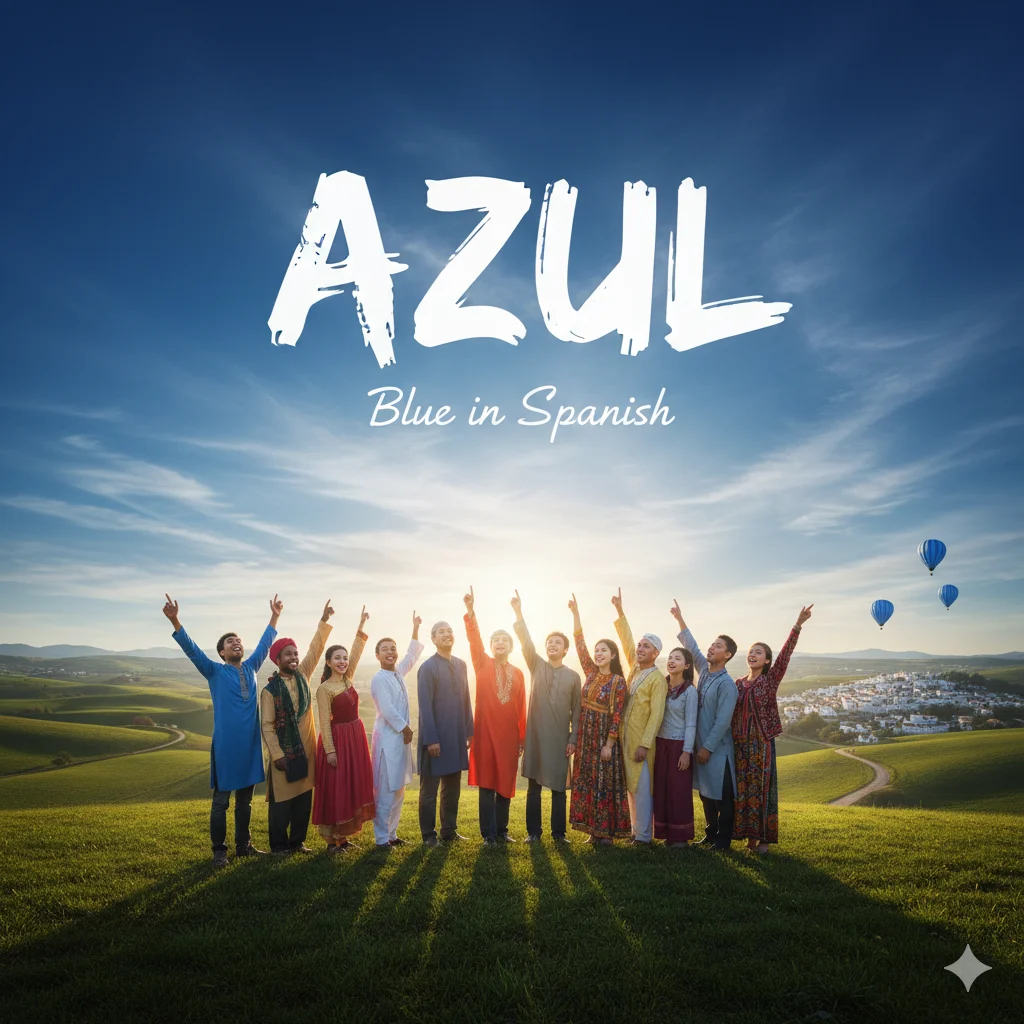
Have you ever noticed how the color blue feels like peace?
It’s the endless sky above us, the calm of the ocean, the promise of a clear day.
When I first learned Spanish, one of the most beautiful words I discovered was “azul” — pronounced ah-sool. The sound itself feels like a breeze, soft and flowing, just like the color it describes.
But blue isn’t just a color; it’s a story told differently in every culture — from the deep “azul del mar” (blue of the sea) in Spain to the vibrant “azul celeste” (sky blue) of Latin America.
Learning how to say blue in Spanish opens a window into how language gives emotion to color — how a single shade can carry centuries of art, poetry, and meaning.
🌍 Table: How to Say “Blue” in Different Languages
| Language | Word for Blue | Cultural Insight |
|---|---|---|
| Spanish | Azul | Represents calm, trust, and the Mediterranean sky. |
| English | Blue | Symbolizes peace, sadness, and loyalty. |
| French | Bleu | Associated with royalty and elegance. |
| Italian | Blu / Azzurro | “Blu” for dark shades, “azzurro” for sky tones — Italy’s national color. |
| German | Blau | Conveys tranquility but also dreaminess. |
| Portuguese | Azul | Common in Brazil and Portugal; tied to sea and spirit. |
| Turkish | Mavi | A sacred color symbolizing protection and the evil eye. |
| Arabic | Azraq (أزرق) | Linked to the vast desert sky and spiritual depth. |
| Japanese | Aoi (青い) | Traditionally represents freshness, youth, and purity. |
| Mandarin Chinese | Lán (蓝) | Symbol of immortality and harmony. |
| Hindi | Neela (नीला) | Sacred in Hinduism — Lord Krishna is often depicted in blue. |
| Swahili | Bluu / Samawati | Associated with calmness and the sea. |
| Zulu | Luhlaza okwesibhakabhaka | Literally means “the color of the sky.” |
| Greek | Ble (μπλε) | Tied to the Aegean Sea and national pride. |
| Maori | Kikorangi | Means “the color of the sky”; spiritual and poetic. |
🇪🇸 How to Say Blue in Spanish
The Spanish word for “blue” is azul (ah-sool).
It’s used to describe everything from the sky (el cielo azul) to the ocean (el mar azul), and even emotions, as in “un día azul” (a peaceful day).
Cultural Insight:
In Spanish-speaking cultures, azul often symbolizes serenity, loyalty, and imagination. It’s also present in flags, art, and music — for instance, “azul” is a recurring theme in Latin American songs and poetry.
Interestingly, Spanish doesn’t stop at just “azul.” There are many shades that tell their own stories:
- Azul claro – light blue
- Azul marino – navy blue
- Azul celeste – sky blue
- Azul oscuro – dark blue
- Azul turquesa – turquoise
When you say azul in Spanish, you’re not just naming a color — you’re describing a feeling.
🇪🇺 How to Say Blue in European Languages
Europe’s languages paint blue with centuries of art and symbolism.
- French – Bleu: Associated with royalty, elegance, and art.
- Italian – Blu / Azzurro: “Azzurro” is Italy’s national color, symbolizing the sky and optimism.
- German – Blau: Linked to freedom and dreams — “Ich bin ganz blau” even means “I’m dreamy” or “tipsy”!
- Greek – Ble: Inspired by the endless blue of the Mediterranean.
- Portuguese – Azul: In Portugal, blue tiles (azulejos) are iconic — storytelling in ceramic form.
In Europe, blue is both noble and emotional — a color that defines peace, depth, and creativity.
🌏 How to Say Blue in Asian Languages
Asia gives blue deep spiritual and cultural meaning.
- Arabic – Azraq (أزرق): Represents vastness and divine beauty.
- Hindi – Neela (नीला): Sacred to Hindus — Lord Krishna, the divine protector, is always blue.
- Chinese – Lán (蓝): Symbolizes harmony and immortality.
- Japanese – Aoi (青い): Means both “blue” and “green” in older usage — reflecting nature’s unity.
- Korean – Pureunsek (푸른색): Expresses hope, youth, and honesty.
- Turkish – Mavi: Deeply symbolic; the “Nazar Boncuğu” (evil eye charm) is bright blue for protection.
- Thai – See faa (สีฟ้า): The color of the sky; associated with Thursday and good fortune.
- Vietnamese – Xanh da trời: Literally “the color of the sky.”
In Asia, blue connects the earthly and the divine — a bridge between peace and purity.
🌍 How to Say Blue in African Languages
Africa’s relationship with blue often reflects spirituality, environment, and tradition.
- Swahili – Samawati: Means “sky-colored”; tied to calmness and the ocean.
- Zulu – Luhlaza okwesibhakabhaka: Poetic phrase meaning “the color of the heavens.”
- Yoruba – Buluu: Modern adoption; linked to water and peace.
- Amharic – Semayawi: Literally “sky-like”; used in art and clothing.
- Somali – Buluug: Prominent in the Somali flag — symbolizing unity and freedom.
- Berber – Azegzaw: Represents Tuareg nomads, known as the “blue men of the desert.”
- Hausa – Shuɗi: Associated with dignity and calmness.
- Igbo – Ucha anụ mmiri: “The color of water”; reflects fluidity and life.
- Afrikaans – Blou: Derived from Dutch; a symbol of nature and openness.
- Lingala – Bleu: Adopted from French, showing language evolution in Central Africa.
Across Africa, blue is a living symbol — of life, sky, and divine protection.
🌺 How to Say Blue in Indigenous & Island Languages
- Hawaiian – Uliuli: Deep ocean blue, tied to nature and peace.
- Maori – Kikorangi: “Color of the sky”; spiritual and poetic.
- Samoan – Lanumoana: “Color of the sea”; symbolizes vitality.
- Cherokee – Sakonige: Represents truth and clarity.
- Fijian – Uli: Associated with water and calm energy.
- Tahitian – Uliuli: Refers to dark blue; sacred and protective.
- Guaraní – Hovy: Means “blue” and symbolizes truth and purity.
- Inuit – Sikumit: Relates to the color of frozen sea ice.
- Haitian Creole – Ble: Adopted from French but full of local warmth.
- Tagalog – Asul: Derived from Spanish “azul,” showing linguistic connection.
Island and indigenous cultures treat blue not as a pigment but as a presence — a sacred color tied to water, life, and the heavens.
💬 Cultural Insights: The Story Behind “Azul”
The Spanish word “azul” has Arabic roots — from “lāzaward,” meaning lapis lazuli, the blue gemstone once more valuable than gold.
This history reminds us how language and trade intertwined to bring color to words.
Blue has always been the color of trust, calm, and imagination — across flags, oceans, and skies.
It’s the color of distance and dreams — something we look at, long for, and find peace in.
🌸 Proverbs and Sayings About Blue
- Spanish: “Día azul, corazón tranquilo.” — “Blue day, peaceful heart.”
- English: “Once in a blue moon.” — Something rare and special.
- Japanese: “青は藍より出でて藍より青し” — “Blue comes from indigo, but is bluer than indigo.” (The student surpasses the master.)
- Arabic: “The blue sky hides its secrets.”
- African Proverb: “The sky is wide enough for all birds to fly.”
Colors carry wisdom — and blue, in every language, teaches serenity and vastness.
❓ FAQs
Q1: What is “blue” in Spanish?
The word for “blue” in Spanish is azul (ah-sool).
Q2: How do you pronounce “azul”?
It’s pronounced “ah-sool,” with a soft “z” sound like an “s.”
Q3: What does blue symbolize in Spanish culture?
In Spain and Latin America, azul represents calmness, loyalty, and honesty.
Q4: Does “azul” have different shades in Spanish?
Yes! “Azul claro” (light blue), “azul marino” (navy), and “azul celeste” (sky blue) are common variations.
Q5: What is the origin of the word “azul”?
It comes from Arabic lazaward, meaning lapis lazuli — the precious blue stone of ancient art.
❤️ Conclusion: The Universal Language of “Azul”
Whether you say azul, blue, bleu, or aoi, the color remains the same — a reflection of peace, hope, and infinity.
So, next time you look at the sky and whisper “qué azul tan hermoso” (“what a beautiful blue”), remember — you’re speaking the shared language of humanity.
💬 Now it’s your turn!
How do you say “blue” in your language? Share it in the comments below — let’s paint the world in every shade of azul. 🎨💙