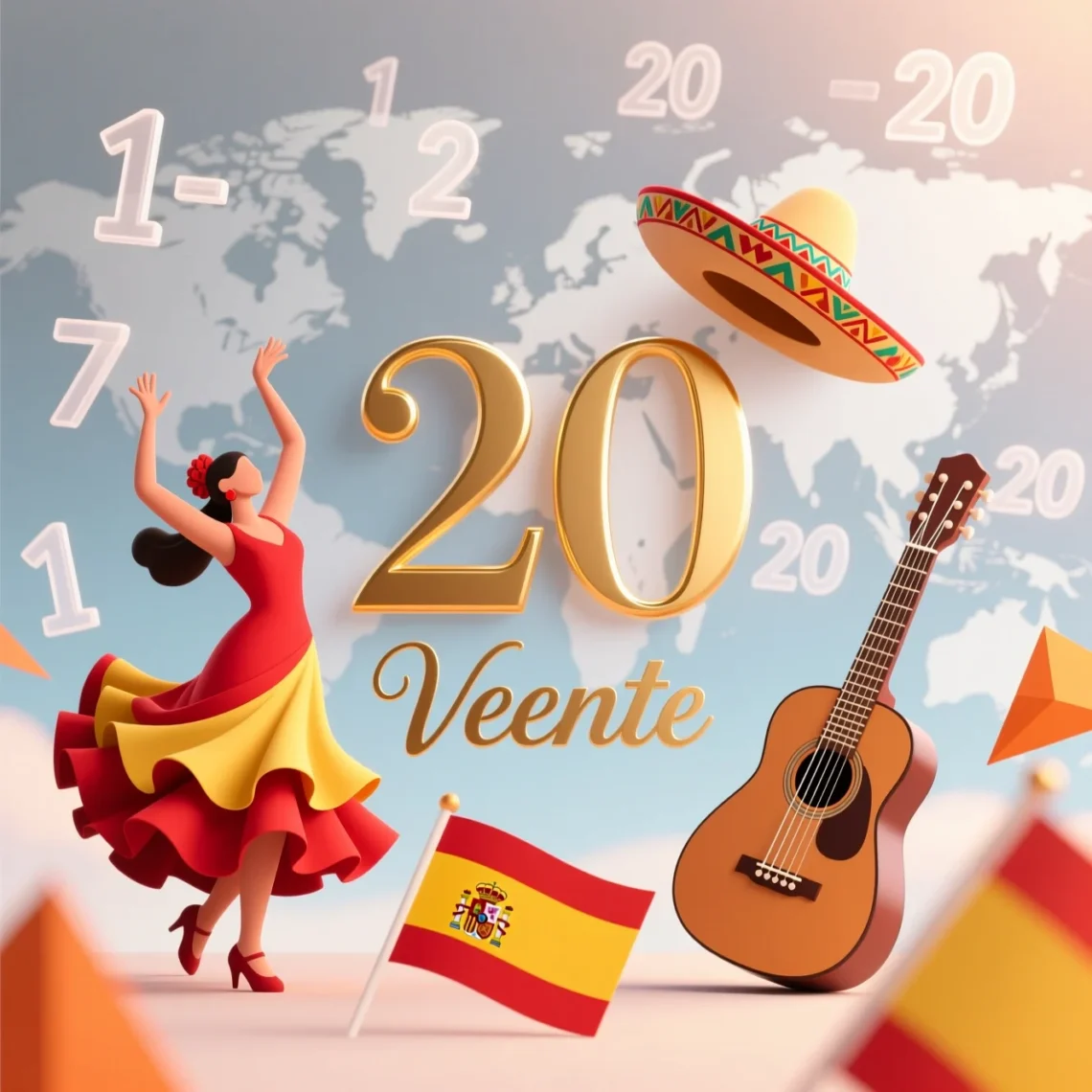
When I first began learning Spanish, I remember stumbling over the number “veinte.” It wasn’t just the pronunciation (BAYN-teh) — it was the rhythm of the word, the musicality that made Spanish sound so alive.
Numbers are among the first things we learn in any language. Yet behind each one lies a story — a rhythm, a pattern, a reflection of how a culture organizes thought. Saying “20” in Spanish isn’t just about arithmetic; it’s about connecting with a language spoken by over 500 million people across 20+ countries.
From Madrid to Mexico City, from Bogotá to Buenos Aires, veinte is more than a number — it’s a bridge between people and worlds.
🔢 Table: How to Say 20 in Different Languages
| Language | Word/Phrase for “20” | Cultural or Linguistic Insight |
|---|---|---|
| Spanish | Veinte | From Latin “viginti”; rhythmic and smooth, typical of Spanish phonetics. |
| English | Twenty | Derived from Old English “twentig”; widely used in global contexts. |
| French | Vingt | Nasal sound typical of French pronunciation, meaning “twenty.” |
| Italian | Venti | Very similar to Spanish; reflects shared Latin roots. |
| Portuguese | Vinte | Another Romance language variation of the Latin “viginti.” |
| German | Zwanzig | Comes from Proto-Germanic roots; more complex structure. |
| Russian | Dvadtsat’ (Двадцать) | Reflects Slavic number formation system. |
| Arabic | Ishrūn (عشرون) | Derived from the word for “ten”; part of a base-10 system. |
| Hindi | Bees (बीस) | Simple and clear; used widely in everyday communication. |
| Chinese (Mandarin) | Èrshí (二十) | Literally means “two tens,” showing logical numerical structure. |
| Japanese | Nijū (二十) | Also means “two tens”; shows East Asian base-10 logic. |
| Swahili | Ishirini | Adopted from Arabic, symbolizing centuries of cultural exchange. |
| Turkish | Yirmi | Part of Turkic numeral system; short and easy to pronounce. |
| Korean | Seumul (스물) | Represents harmony and completeness in Korean culture. |
| Greek | Eíkosi (είκοσι) | From ancient Greek “eíkosi,” nearly unchanged for millennia. |
🇪🇸 How to Say 20 in Spanish
The number 20 in Spanish is “veinte.”
Pronunciation: BAYN-teh
IPA: /ˈbeinte/
It’s one of those words that roll off the tongue easily once you hear it spoken by a native speaker.
Cultural Insight:
Spanish is a musical language — even its numbers have rhythm. The “ei” sound in veinte gives it a bright, open tone, which is common in Spanish words that express lightness and movement.
In Spain and Latin America, numbers are part of everyday poetry — from counting dance steps in flamenco to keeping rhythm in salsa, or reciting childhood rhymes like:
“Uno, dos, tres, veinte pies.”
(“One, two, three, twenty feet.”)
Learning how to say 20 in Spanish opens a door not only to math but also to the heart of the world’s second-most spoken native language.
🌎 Veinte Across Spanish-Speaking Countries
Spanish is spoken in 21 countries, and while “veinte” is universally used, pronunciation and intonation differ beautifully:
- Spain: Crisp “v” sound — “BAYN-teh.”
- Mexico: Softer and smoother — “BEHN-teh.”
- Argentina: Often shortened or slurred slightly in quick speech.
- Colombia: Clear and rounded vowels — very easy for learners.
- Caribbean (Cuba, Puerto Rico, Dominican Republic): Fast, melodic rhythm with musical flair.
These small variations show the diversity and richness of the Spanish-speaking world — one word, many voices.
🇪🇺 European Languages: How Other Cultures Say 20
Europe is home to multiple Romance and Germanic languages that shaped modern Spanish.
- French – Vingt (vã): Shares Latin origins; pronounced with a nasal tone.
- Italian – Venti: Almost identical to veinte, differing only in the final vowel.
- Portuguese – Vinte: A blend of soft consonants, much like Spanish.
- German – Zwanzig: A completely different linguistic path, from Proto-Germanic.
- Greek – Eíkosi: Ancient Greek heritage preserved through centuries.
These similarities highlight the shared ancestry between European tongues — Latin is the invisible thread tying them together.
🌏 Asian Languages: How to Say 20 Around the East
- Mandarin (Èrshí): Literally “two tens.”
- Japanese (Nijū): Same concept, “two tens.”
- Hindi (Bees): Commonly used across India; rhythmic and simple.
- Korean (Seumul): Reflects harmony — twenty marks adulthood in traditional Korean culture.
- Arabic (Ishrūn): Means “two tens,” mirroring base-10 structure from ancient civilizations.
Even though the words sound different, the mathematical logic of 20 is the same — proof that human minds everywhere think in patterns.
🌍 African and Indigenous Number Systems
African and indigenous communities have long, rich counting traditions, some of which predate written language.
- Swahili – Ishirini: Borrowed from Arabic centuries ago through trade.
- Yoruba – Ogún: Represents not just a number but a rhythm in drumming and storytelling.
- Zulu – Amashumi amabili: Literally “two tens,” mirroring global base-10 logic.
- Hausa – Ashirin: Another Arabic-influenced term, showing ancient linguistic blending.
- Maasai (Kenya) – Ishirini: Adopted and localized pronunciation.
Counting, in many African cultures, is deeply connected to rhythm, music, and communal life — numbers are heard, not just said.
💬 Cultural Insights: The Story Behind “Veinte”
The Spanish word veinte comes from the Latin viginti, meaning twenty. Over time, it evolved through Old Spanish into its modern form.
Beyond math, the number 20 often represents completion, balance, and clarity.
In tarot, for example, the number 20 symbolizes awakening and judgment. In many Latin traditions, cumplir veinte años (turning 20 years old) is a milestone — the symbolic beginning of adulthood.
So, saying “veinte” isn’t just about numbers — it’s about counting the moments that matter.
🌸 Proverbs and Sayings About Numbers
- Spanish: “A los veinte años, se vive deprisa.” — At twenty, life moves fast.
- English: “You’re only twenty once.”
- French: “À vingt ans, tout est permis.” — At twenty, everything is allowed.
- Japanese: “二十歳は成人。” (Nijussai wa seijin) — “At 20, you are an adult.”
- Swahili: “Kumi na kumi ni ishirini.” — Ten and ten make twenty (used metaphorically for cooperation).
Numbers remind us that growth, age, and learning are universal — no matter the language.
❓ FAQs
Q1: What is 20 in Spanish?
The number 20 in Spanish is “veinte.”
Q2: How do you pronounce “veinte”?
Pronounced BAYN-teh — the “v” sounds like a soft “b.”
Q3: Is “veinte” used everywhere in Spanish-speaking countries?
Yes, it’s universal — though accents differ slightly between regions.
Q4: What’s the origin of “veinte”?
It comes from the Latin “viginti,” meaning twenty, reflecting Spain’s Roman heritage.
Q5: Why is it useful to learn numbers in Spanish?
Because numbers appear in prices, dates, addresses, phone numbers, and everyday conversation — mastering them helps you sound natural and confident.
❤️ Conclusion: Beyond Counting — The Spirit of Veinte
Numbers are more than symbols — they’re stories. Saying “veinte” isn’t just about learning Spanish; it’s about touching a living language that connects millions.
Whether you’re shopping in Madrid, dancing in Mexico, or learning online — every time you say veinte, you’re sharing in the heartbeat of a global culture.
💬 Now it’s your turn!
Try saying “veinte” aloud — then comment below how you say 20 in your own language. Let’s count together across cultures! 🌎