Before we say “hello,” before we learn to walk, there’s one word that often becomes our very first — Mommy.
I still remember my first trip to Mexico. A little girl ran to her mother shouting, “¡Mamá!” — her voice filled with love, joy, and trust. That single word spoke louder than any dictionary definition. It was the sound of home.
Learning how to say mommy in Spanish is not just about translation. It’s about understanding how love, family, and warmth are expressed in one of the world’s most emotional languages.
And when we look beyond Spanish, we find that every language has its own beautiful way to honor the one who gave us life.
🗺️ Table: How to Say “Mommy” in 15 Languages
| Language | Word/Phrase for “Mommy” | Cultural Insight |
|---|---|---|
| Spanish | Mamá | Used lovingly across Spanish-speaking countries; soft and affectionate. |
| English | Mom / Mommy | Universal and emotional; often a child’s first word. |
| French | Maman | Gentle and melodic; widely used by children and adults. |
| Italian | Mamma | Full of emotion and warmth; similar to Spanish. |
| Portuguese | Mamãe | Expresses deep affection and closeness in Brazilian families. |
| German | Mama / Mutti | “Mama” is common; “Mutti” is more traditional. |
| Russian | Mama (Мама) | Same pronunciation; shows maternal tenderness. |
| Turkish | Anne / Annee | A word of respect and love; mothers hold a sacred place. |
| Arabic | Ummi (أمي) | Means “my mother”; highly respected and deeply emotional. |
| Hindi | Maa (माँ) | Spiritually significant, often associated with divine motherhood. |
| Swahili | Mama | Same word as in English; shows Africa’s linguistic influence. |
| Zulu | Umama | A central figure in family and community life. |
| Japanese | Okaasan (お母さん) | Shows respect and care; used by both children and adults. |
| Mandarin (Chinese) | Māma (妈妈) | Very similar to “Mama” in sound; represents affection. |
| Korean | Eomma (엄마) | Soft, emotional term; symbolizes love and respect. |
🇪🇸 How Do You Say Mommy in Spanish?
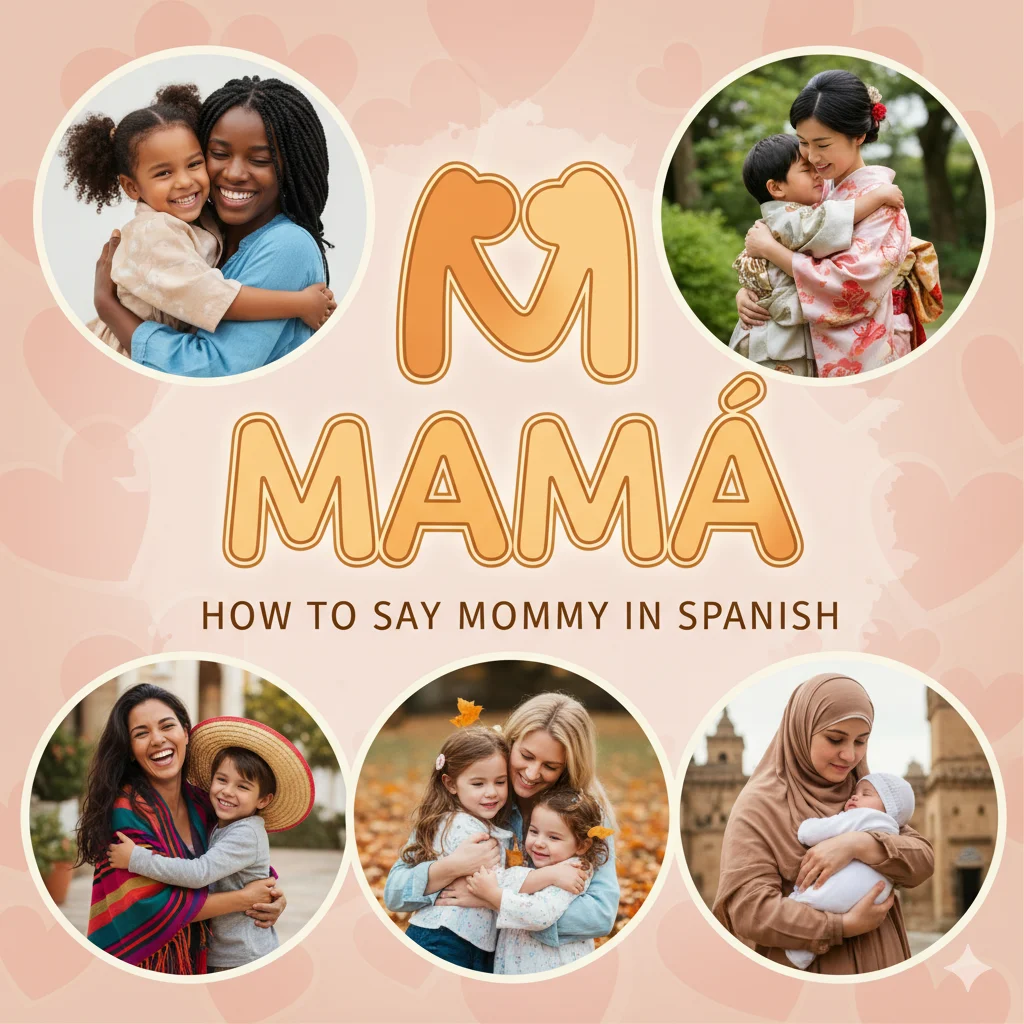
The Spanish word for “mommy” is “Mamá” (pronounced mah-MAH).
It’s one of the most tender words in the Spanish language — simple, musical, and filled with affection. Spanish-speaking families use “Mamá” both in daily life and emotional moments. You’ll often hear phrases like:
- Te quiero, mamá — “I love you, Mom.”
- Mi mamá es mi vida — “My mom is my life.”
In Spain, Latin America, and beyond, mothers are the heart of the family. They are celebrated not just on Mother’s Day (Día de la Madre), but every single day — through songs, traditions, and everyday warmth.
🇪🇺 How to Say Mommy in European Languages
Across Europe, words for “mommy” carry melodies of tenderness:
- French — Maman: Elegant and emotional, often said with affection.
- Italian — Mamma: Expressive and musical, featured in lullabies and songs.
- Portuguese — Mamãe: In Brazil, children call their mothers mamãe with heartfelt emotion.
- German — Mama: Universally used; shows Germany’s evolving family warmth.
- Greek — Mama (Μαμά): Identical to “mama,” proving that love truly transcends language.
In European cultures, the mother is often the emotional pillar — nurturing, protective, and endlessly loving.
🌏 How to Say Mommy in Asian Languages
Asia’s diversity brings a beautiful variety to how we say “mommy”:
- Hindi — Maa (माँ): A sacred word; many Indian prayers reference “Maa” as divine love.
- Arabic — Ummi (أمي): Literally “my mother,” used with deep respect and devotion.
- Turkish — Anne: A blend of love and reverence; often the emotional center of family life.
- Japanese — Okaasan (お母さん): Formal yet gentle; Japanese culture honors mothers with deep respect.
- Korean — Eomma (엄마): Warm and emotional; often used in heartfelt TV dramas and songs.
- Mandarin — Māma (妈妈): Children use it affectionately; the sound feels natural and loving.
- Thai — Mae (แม่): Central to Thai culture, symbolizing care and kindness.
- Vietnamese — Mẹ: Pronounced softly, expressing deep filial affection.
In many Asian traditions, the concept of “mother” is sacred — associated with compassion, sacrifice, and divine care.
🌍 How to Say Mommy in African Languages
Across Africa, mothers are revered as life-givers and community builders.
- Swahili — Mama: Used widely in East Africa; both a title of respect and affection.
- Zulu — Umama: Represents nurturing strength within the family.
- Yoruba (Nigeria) — Iya: Deeply respected; often linked to ancestral honor.
- Amharic (Ethiopia) — Emaye: Soft and emotional, celebrating motherhood.
- Akan (Ghana) — Na: Revered figure, central in family and spiritual traditions.
- Hausa (Nigeria) — Uwa: Symbolizes life and continuity.
- Shona (Zimbabwe) — Amai: Means both “mother” and “respectful woman.”
- Somali — Hooyo: A term of love and protection.
- Xhosa — Mama: Used like “mommy” — affectionate and familiar.
African greetings for mothers are more than linguistic — they’re cultural celebrations of life and womanhood.
🌺 How to Say Mommy in Indigenous & Island Languages
From island nations to indigenous tribes, the bond between mother and child is poetic and spiritual:
- Hawaiian — Makua wahine: Means “female parent”; often replaced by “Mama” in modern use.
- Maori — Whaea: Symbolic of both mother and teacher.
- Samoan — Tinā: Means mother; used with deep love.
- Cherokee — Agitsi: A beautiful word meaning “my mother.”
- Tahitian — Metua vahine: Literally “female parent”; sacred in family rituals.
- Fijian — Tina: A soft, comforting word.
- Inuit — Anana: Used in Arctic regions, symbolizing warmth in cold environments.
- Haitian Creole — Manman: French influence, pronounced with island charm.
- Tagalog — Nanay: Central to Filipino culture; “Nanay” means love, patience, and home.
- Guaraní — Sy: Brief yet powerful, showing the mother’s silent strength.
These words prove that no matter where we live, the love for “mommy” speaks the same emotional language.
💬 Cultural Insights: The Language of Motherhood
“Mamá,” “Maman,” “Mama,” “Maa” — no matter the sound, the feeling is identical.
Linguists note that the “ma” sound appears in nearly every language because it’s one of the first sounds babies can make — an instinctive expression of love and comfort.
From lullabies in Latin America to prayers in India, mothers are celebrated as givers of life, peace, and wisdom.
🌸 Proverbs About Mothers Around the World
- Spanish: “Madre hay una sola.” — “There’s only one mother.”
- Arabic: “Heaven lies under the feet of mothers.”
- Turkish: “The hand that rocks the cradle rules the world.”
- Chinese: “A mother’s love is like water — deep and endless.”
- African Proverb: “A mother’s love never ages.”
Each proverb whispers the same truth: the word for mother may change, but her love never does.
❓ FAQs
Q1: How do you say Mommy in Spanish?
The word for “Mommy” in Spanish is “Mamá.” It’s affectionate, emotional, and widely used in all Spanish-speaking countries.
Q2: How do you pronounce Mamá?
Pronounced mah-MAH, with the stress on the final syllable.
Q3: What’s the difference between “Madre” and “Mamá”?
“Madre” is the formal term for “mother,” while “Mamá” is the affectionate version, similar to “Mommy.”
Q4: Why do so many languages use “ma” sounds for mother?
Because it’s one of the first sounds babies make — naturally evolving into “Mama” in many cultures.
Q5: Is Mamá used the same way in all Spanish-speaking countries?
Yes, but accents and expressions vary. In Mexico, it’s tender; in Spain, it’s familiar; in Argentina, often said with emotional warmth.
❤️ Conclusion: A Universal Word of the Heart
Whether you say Mamá, Maman, Maa, or Mama, the meaning remains unchanged — love, care, and life itself.
Learning how to say Mommy in Spanish opens your heart to one of the most emotional words in any language. Because wherever you go, and whatever you call her, a mother’s love speaks without translation.
💬 Now it’s your turn:
How do you say “Mommy” in your language? Share your word below — let’s create a global tribute to mothers everywhere. 🌎💐