Before we learn to walk, before we say our first sentences, we all speak one universal word — “Mom.”
When I first heard a Korean child running toward his mother shouting “Eomma!” (엄마) in Seoul, it was instantly familiar. Though the language was different, the sound carried the same tenderness I once used for my own mother.
That’s the beauty of language — the words may change, but the emotion never does.
Learning how to say mom in Korean isn’t just about translation; it’s about understanding a deep bond that transcends cultures, borders, and generations.
🗺️ Table of “Mom” in Different Languages
| Language | Word for Mom | Cultural Insight |
|---|---|---|
| Korean | Eomma (엄마) | Used affectionately by children; means “Mom” in everyday life. |
| English | Mom / Mother | “Mom” is casual; “Mother” adds formality and respect. |
| French | Maman | Soft and affectionate; often used by all ages. |
| Spanish | Mamá | Expressive and emotional, often said with warmth. |
| Italian | Mamma | Central to family life and emotion in Italian culture. |
| German | Mama / Mutter | “Mama” for affection; “Mutter” for formal speech. |
| Japanese | Okaasan (お母さん) | Polite form showing respect and love. |
| Chinese (Mandarin) | Māma (妈妈) | Direct and affectionate; easy for children to say. |
| Hindi (India) | Maa (माँ) | Deeply emotional; used in songs, prayers, and poetry. |
| Arabic | Ummi (أمي) | Literally “my mother”; holds high spiritual respect. |
| Swahili | Mama | Common across East Africa; shows warmth and closeness. |
| Zulu | Umama | Means “the mother”; central to family and community. |
| Russian | Mama (Мама) | Used in daily speech with affection. |
| Greek | Mama (Μαμά) | Universal term of love and care. |
| Turkish | Anne | Respected, affectionate term for mothers in Turkey. |
🇰🇷 How Do You Say Mom in Korean?
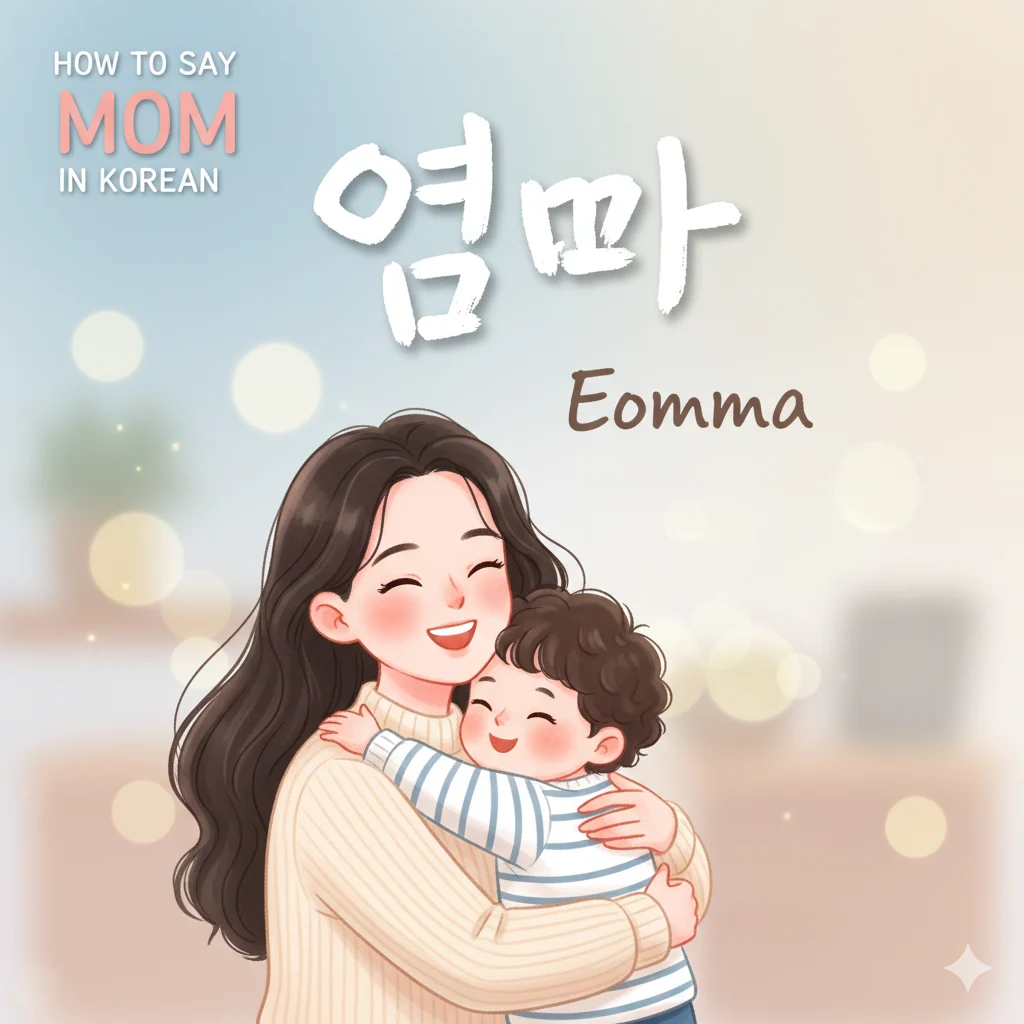
The Korean word for “mom” is 엄마 (Eomma) — pronounced uhm-mah.
It’s the word children use every day to call their mothers with love, joy, or even playfulness.
For formal situations, Koreans use 어머니 (Eomeoni) — a more respectful and polite form, similar to “Mother” in English.
Cultural Insight:
In Korean culture, mothers are the heart of the family — nurturing, guiding, and often sacrificing silently. Words like Eomma carry layers of love, duty, and gratitude. Saying it softly can express affection, but saying it with tears can express pain, apology, or longing.
So, learning how to say mom in Korean is more than mastering pronunciation — it’s understanding the emotional weight behind the word.
🇪🇺 How to Say Mom in European Languages
Europe’s family-centered cultures each have endearing words for mothers:
- France — Maman: Gentle and timeless, often followed by a kiss on the cheek.
- Italy — Mamma: Symbol of warmth and home-cooked comfort.
- Spain — Mamá: Loving and expressive; spoken with strong emotion.
- Germany — Mama / Mutter: “Mama” feels intimate; “Mutter” carries respect.
- Greece — Mama: Reflects both tenderness and reverence.
- Russia — Mama (Мама): One of the first words every child says — across generations.
- Poland — Mama: The sound of security and family affection.
In Europe, “Mom” represents not just the parent but the emotional center of home and tradition.
🌏 How to Say Mom in Asian Languages
Across Asia, the word for “mom” often sounds familiar, showing shared human roots:
- Korea — Eomma (엄마): Everyday love between children and mothers.
- Japan — Okaasan (お母さん): Respectful and tender, blending politeness with affection.
- China — Māma (妈妈): Among the easiest words for children to learn — reflecting its natural tone.
- India — Maa (माँ): Deeply spiritual; used in poetry, prayers, and cinema.
- Thailand — Mae (แม่): Gentle and affectionate, symbolizing care.
- Vietnam — Mẹ: The heart of the family and the symbol of sacrifice.
- Philippines — Nanay: Rooted in nurturing and everyday warmth.
- Indonesia — Ibu: Both affectionate and formal — literally means “mother” and “lady.”
- Arabic Countries — Ummi: Means “my mother”; often used as a term of reverence.
- Persian (Iran) — Madar: Both poetic and powerful — used with deep respect.
Asian cultures honor motherhood as sacred — every language wraps the word “mom” in emotion, respect, and gratitude.
🌍 How to Say Mom in African Languages
African cultures celebrate motherhood as the foundation of community and strength:
- Swahili — Mama: A universal and affectionate word.
- Zulu — Umama: Rooted in the idea of care and leadership within families.
- Yoruba — Iya: Revered in tradition and spiritual heritage.
- Amharic — Enat: Means “mother,” often associated with wisdom.
- Hausa — Uwa: A term of respect and love.
- Shona — Amai: Central figure in Shona families — the giver of life.
- Akan (Ghana) — Na: A spiritual and familial title of honor.
- Somali — Hooyo: Gentle, affectionate, and full of emotion.
- Berber — Tamettut: Symbolic of birth and continuity.
- Lingala — Mama: Used warmly in everyday conversation.
Across Africa, mothers are celebrated as life-givers, teachers, and protectors — their title carries deep communal pride.
🌺 How to Say Mom in Indigenous & Island Languages
From the Pacific to the Americas, maternal love takes many names — but one meaning: life.
- Hawaiian — Makuahine: Sacred and loving; often used in chants and songs.
- Maori — Whaea: Means both “mother” and “female elder.”
- Samoan — Tinā: A word of respect and gratitude.
- Cherokee — Etsi: Used for both biological and spiritual mothers.
- Fijian — Tina: Symbolizes nurture and care.
- Tahitian — Metua vahine: “Female parent,” said with respect.
- Inuit — Anaana: Softly spoken; conveys love and protection.
- Haitian Creole — Manman: Derived from French “maman,” spoken with island warmth.
- Tagalog — Nanay: The center of family life in Filipino culture.
- Guaraní — Sy: Deeply emotional word meaning mother or nurturer.
In Indigenous languages, the word for “mom” is sacred — a bridge between generations, ancestors, and the spirit of life itself.
💬 Cultural Insights: Why “Mom” Sounds Similar Everywhere
Have you noticed how Mama, Maman, Amma, Maa, Umma, Eomma all sound alike?
That’s not coincidence — it’s biology.
Linguists say that babies naturally form sounds like “m” and “a” first. Across history, these earliest syllables became “mama,” “maa,” and similar words — showing that the bond between child and mother literally shaped human language itself.
No wonder “Eomma” in Korean feels both unique and universally familiar.
🌸 Proverbs About Mothers Around the World
- Korean: “A mother’s heart is a deep ocean where you will always find forgiveness.”
- Arabic: “Heaven lies under the feet of mothers.”
- Chinese: “A mother’s love is deeper than the sea.”
- Turkish: “The one who rocks the cradle rules the world.”
- African Proverb: “A mother is a school; if she is well taught, the whole nation is well educated.”
- Italian: “Of all love, mother’s love is the most sincere.”
Every culture speaks of mothers with reverence — proving that love, not language, is what truly connects us.
❓ FAQs
Q1: How do you say mom in Korean?
You say Eomma (엄마) for “mom” and Eomeoni (어머니) for “mother” in Korean.
Q2: How do you pronounce Eomma?
Pronounce it uhm-mah with a soft “uh” sound.
Q3: What’s the difference between Eomma and Eomeoni?
“Eomma” is informal and affectionate — used with family. “Eomeoni” is formal, showing respect, used by adults or in polite settings.
Q4: Why do many languages use similar sounds for “mom”?
Because “m” and “a” are the easiest sounds for babies to pronounce — leading to universal similarities.
Q5: What does motherhood mean in Korean culture?
Mothers are symbols of sacrifice, guidance, and unconditional love. The word Eomma embodies deep emotion and family values.
❤️ Conclusion: “Eomma” — The Sound of Home
No matter where we’re from, the word for Mom carries the same meaning — love, safety, and belonging.
In Korean, Eomma holds generations of affection, care, and strength. It’s not just a word; it’s a song every heart knows.
So, next time you hear a child call “Eomma,” remember — that sound is the echo of humanity’s oldest and purest emotion: love.
💬 Now it’s your turn:
How do you say “Mom” in your language? Share it below, and let’s celebrate mothers from every corner of the world. 🌸