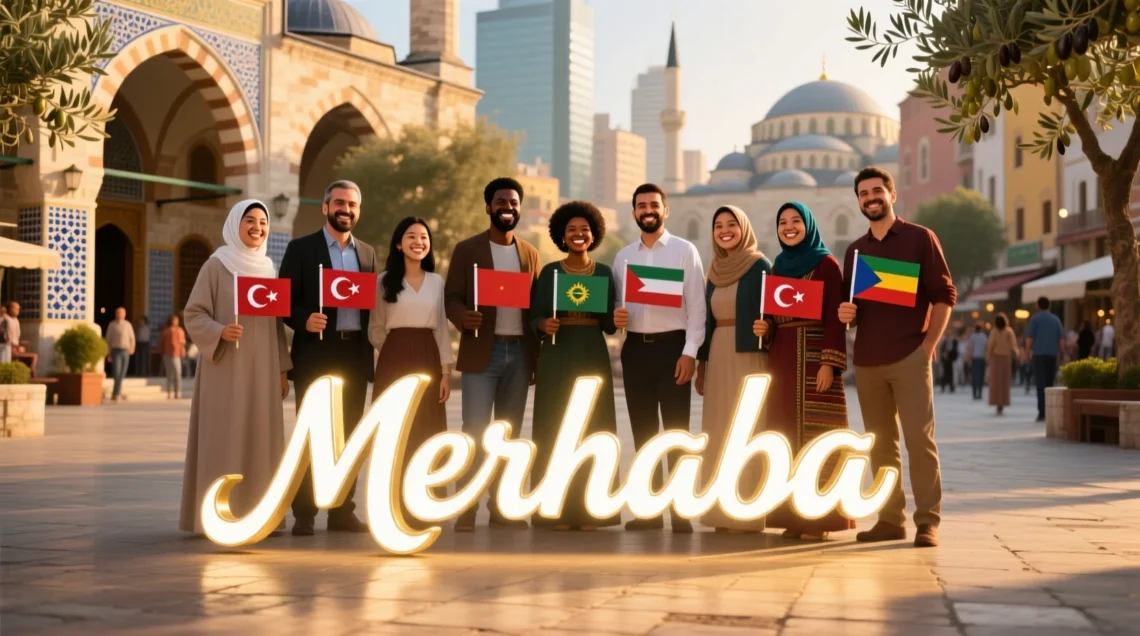
When you travel to Turkey, the first word you’ll likely hear is “Merhaba.”
It rolls off the tongue softly — warm, melodic, and full of welcome.
The first time I heard it was in Istanbul’s Grand Bazaar. A smiling shopkeeper called out, “Merhaba, my friend!” It wasn’t just a hello — it was an embrace in word form. That simple greeting made me feel instantly connected to the place and its people.
So, how do you say hello in Turkish? You say “Merhaba” (mehr-hah-bah) — a word that carries centuries of friendship, respect, and openness.
Let’s explore how this greeting fits into a wider global tradition — the beautiful art of saying hello.
🗺️ Table of Greetings Around the World
| Language | Word/Phrase for “Hello” | Cultural Insight |
|---|---|---|
| Turkish | Merhaba | Universal Turkish greeting meaning “hello”; used in all contexts. |
| English | Hello / Hi | Friendly, casual greeting; globally recognized. |
| French | Bonjour | Means “good day”; a polite start to every conversation. |
| Spanish | Hola | Cheerful and open; often accompanied by hugs or kisses. |
| Italian | Ciao | Used for both “hello” and “goodbye”; reflects casual warmth. |
| German | Hallo / Guten Tag | “Hallo” is informal, “Guten Tag” more formal. |
| Arabic | As-salamu alaykum | “Peace be upon you”; expresses deep respect. |
| Japanese | Konnichiwa | “Good afternoon”; emphasizes courtesy. |
| Mandarin (Chinese) | Nǐ hǎo (你好) | “You good”; a wish for mutual well-being. |
| Hindi | Namaste (नमस्ते) | “I bow to you”; spiritually grounded greeting. |
| Swahili | Jambo / Habari | Common East African greetings showing friendliness. |
| Zulu | Sawubona | “I see you”; an acknowledgment of presence. |
| Hawaiian | Aloha | A word that means hello, love, and peace all at once. |
| Maori | Kia ora | “Be well”; used for hello, thanks, and good wishes. |
| Russian | Privet (Привет) | Friendly greeting among peers and loved ones. |
🇹🇷 How Do You Say Hello in Turkish?
In Turkish, the word for hello is Merhaba.
It’s pronounced mehr-hah-bah and can be used with anyone — from close friends to strangers. The beauty of this word lies in its simplicity and sincerity.
✨ Cultural Meaning of “Merhaba”
“Merhaba” comes from Arabic roots meaning “to be wide or open.” In Turkish culture, it reflects openness of heart and hospitality — qualities deeply ingrained in daily life.
When you say “Merhaba,” you’re not just greeting someone — you’re expressing acceptance and peace. Turks often follow it with a handshake, a friendly smile, or even tea.
So, next time you wonder how do you say hello in Turkish, remember:
It’s not just a word — it’s a connection.
🇪🇺 How to Say Hello in European Languages
Europe’s greetings vary from polite formality to cheerful friendliness:
- France — Bonjour: A sign of courtesy and warmth.
- Spain — Hola: Often said with hugs and laughter.
- Italy — Ciao: Easygoing, expressive, and musical.
- Germany — Hallo / Guten Tag: Reflects discipline and clarity.
- Greece — Yasou: Literally “to your health,” symbolizing good wishes.
- Netherlands — Hallo: Simple and direct, like Dutch culture.
- Portugal — Olá: A melodic, welcoming tone that feels like sunshine.
Across Europe, a greeting is more than manners — it’s an introduction to the local soul.
🌏 How to Say Hello in Asian Languages
Asia’s greetings carry spirituality, respect, and warmth.
- Japan — Konnichiwa: Accompanied by a polite bow.
- China — Nǐ hǎo: Focused on mutual well-being.
- India — Namaste: A gesture of peace and respect, palms pressed together.
- Korea — Annyeonghaseyo: Means “are you peaceful?” — kindness in question form.
- Arabic World — As-salamu alaykum: “Peace be upon you” — greeting of unity.
- Thailand — Sawasdee ka/krub: Always paired with a bow and smile.
- Vietnam — Xin chào: Gentle and respectful.
- Indonesia — Halo: Friendly and familiar.
- Philippines — Kumusta: Derived from “Cómo está?” — symbol of warmth.
Asian greetings remind us that communication isn’t just words — it’s shared respect.
🌍 How to Say Hello in African Languages
African greetings are about acknowledgment, community, and shared life.
- Swahili — Jambo / Habari: “Hello” or “How are things?” — shows care.
- Zulu — Sawubona: “I see you”; a deep expression of recognition.
- Yoruba — Bawo ni?: “How are you?” — genuine and open.
- Amharic — Selam: Derived from “peace.”
- Akan — Maakye: “Good morning”; changes by time of day.
- Somali — Iska warran?: “What’s new?” — showing interest in others.
- Hausa — Sannu: Respectful greeting used daily.
- Lingala — Mbote: Joyful and lively.
- Berber — Azul: “Peace” — ancient and proud.
Here, greetings are social rituals — often the start of meaningful conversations.
🌺 How to Say Hello in Indigenous & Island Languages
From island shores to indigenous nations, greetings are filled with spirit and connection.
- Hawaiian — Aloha: Love, peace, and hello — all in one word.
- Maori — Kia ora: “Be well”; used as hello, thank you, and good luck.
- Samoan — Talofa: “I am happy to see you.”
- Cherokee — Osiyo: “Hello” with warmth and openness.
- Tahitian — Ia ora na: “May you live”; blessing in greeting form.
- Fijian — Bula: Means “life”; always said joyfully.
- Inuit — Aluu: Simple and sincere.
- Haitian Creole — Bonjou: A friendly morning hello.
- Tagalog — Kumusta: Culturally rich and heartfelt.
- Guaraní — Avy’a rohayhu: “I’m happy to see you.”
Indigenous greetings show how deeply human warmth connects us — across islands and centuries.
💬 Cultural Insights: How “Hello” Evolved Globally
From the Silk Road to smartphones, greetings have evolved — yet their purpose stays the same: to connect hearts.
In Turkey’s ancient marketplaces, merchants used “Merhaba” to welcome travelers. In Arabic, “Salam” spread as a blessing of peace. English “Hello” gained popularity with early telephone calls.
Every version of hello carries a shared truth — we all want to be seen and valued.
🌸 Proverbs About Greeting Across Cultures
- Turkish: “A smiling face is half the greeting.”
- Zulu: “Sawubona” — “I see you.”
- Chinese: “A kind word warms for three winters.”
- Arabic: “Begin with peace, end with peace.”
- Italian: “Who greets first has more friends.”
Greetings are tiny acts of peace — small words that carry immense meaning.
❓ FAQs
Q1: How do you say hello in Turkish?
The Turkish word for hello is Merhaba, pronounced mehr-hah-bah.
Q2: Can “Merhaba” be used formally?
Yes — “Merhaba” is appropriate in both formal and casual settings.
Q3: What does “Merhaba” mean literally?
It comes from Arabic roots meaning “to be wide/open,” symbolizing openness and welcome.
Q4: How do people greet in Turkey besides Merhaba?
You may also hear “Selam” (peace) among friends, or “Günaydın” (good morning).
Q5: Why do greetings vary so much across cultures?
Each culture shapes its greetings from values — peace, respect, joy, or spirituality.
❤️ Conclusion: The Universal Heartbeat of “Merhaba”
So, how do you say hello in Turkish?
You say Merhaba — a word that holds warmth, connection, and humanity.
No matter where you are, a greeting is more than a word; it’s a doorway to friendship. So next time you meet someone new, share your hello — and start your own story of connection.
💬 Your Turn:
How do you say hello in your language? Drop your greeting below and let’s build a world of smiles — one “Merhaba” at a time. 🌎