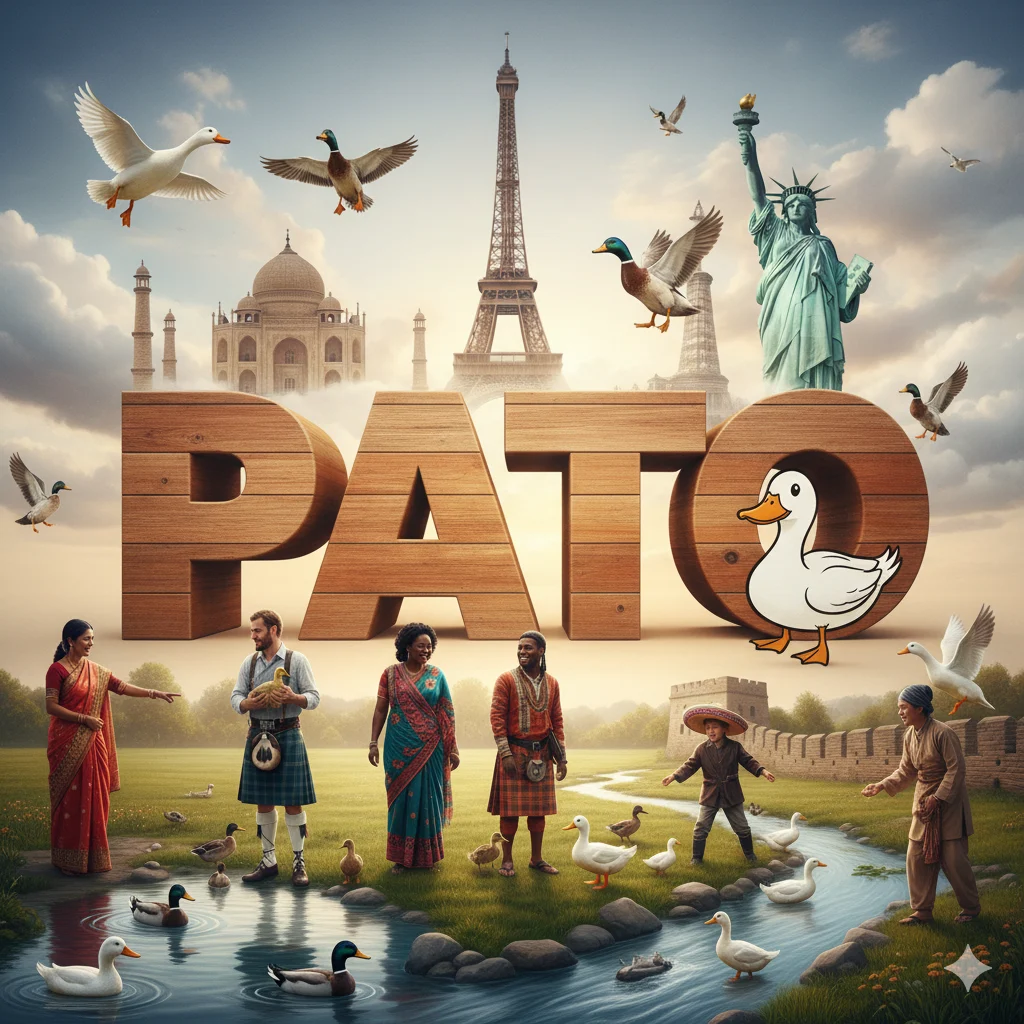
When I first learned Spanish, one of the first words that made me smile was “pato” — it just sounded joyful. I remember sitting by a lake in Madrid, watching a group of ducks glide gracefully over the water, while a little child pointed and shouted, “¡Mira, un pato!” (“Look, a duck!”).
That simple moment reminded me that language connects us not only to people but also to nature. The way we name animals reflects our relationship with them — sometimes playful, sometimes poetic, and sometimes symbolic.
In Turkish, Japanese, or Swahili, the word for “duck” may differ, but the sense of wonder is universal. So today, let’s explore what “duck” means around the world — starting with how to say duck in Spanish: “pato.”
📘 Table of Words for “Duck” Around the World
| Language | Word for “Duck” | Cultural or Linguistic Insight |
|---|---|---|
| Spanish | Pato | Means “duck”; also used idiomatically (e.g., “pato mareado” = dizzy duck). |
| English | Duck | Used literally and as a term of endearment (“Hey, duck!” in the UK). |
| French | Canard | Also used in French cuisine (“confit de canard”). |
| Italian | Anatra | Appears in poetry and folk tales. |
| German | Ente | Common in both idioms and regional dishes. |
| Portuguese | Pato | Same as Spanish — shared linguistic roots. |
| Turkish | Ördek | Used affectionately for children. |
| Arabic | Battah (بطّة) | Means “duck”; also appears in proverbs about calmness. |
| Mandarin Chinese | Yā (鸭) | Symbolizes loyalty and love, especially in pairs. |
| Hindi (India) | Batakh (बतख) | Common rural word; also used in jokes or stories. |
| Swahili | Bata | Used across East Africa; borrowed from Arabic. |
| Zulu | Idada | Found in traditional animal fables. |
| Japanese | Ahiru (アヒル) | Represents cuteness and playfulness in pop culture. |
| Korean | Ori (오리) | Appears in folk songs and cuisine. |
| Maori (New Zealand) | Parera | Often appears in indigenous wildlife traditions. |
🇪🇺 How to Say Duck in European Languages
Europe’s relationship with the duck is both culinary and cultural — from fairy tales to idioms.
- Spanish – Pato: The word carries multiple meanings. In Latin America, “pato” can even be slang for “awkward” or “clumsy,” much like “silly goose” in English.
- French – Canard: Beyond its literal meaning, it’s also a word for a “newspaper” or “false rumor” — showing how language evolves.
- Italian – Anatra: Found in children’s songs and rural sayings.
- German – Ente: In journalism, “Zeitungsente” means “fake news.”
- Portuguese – Pato: Shared with Spanish, emphasizing the linguistic unity of Iberian culture.
- Dutch – Eend: Appears in folk tales and as a popular surname!
European languages treat “duck” with humor, symbolism, and culinary affection — proof that even animals shape our cultural expressions.
🌏 How to Say Duck in Asian Languages
Asia’s words for “duck” often carry symbolic meaning — especially in art, food, and folklore.
- Mandarin Chinese – 鸭 (Yā): Ducks symbolize love and fidelity, often appearing in wedding art as mandarin ducks (鸳鸯, yuānyāng).
- Japanese – アヒル (Ahiru): Represents innocence; often seen in toys, anime, and children’s songs.
- Korean – 오리 (Ori): Symbolizes family unity; “duck meat soup” (오리탕) is a traditional comfort dish.
- Hindi – बतख (Batakh): Common in children’s rhymes and rural life.
- Turkish – Ördek: Used both literally and affectionately (“my little duck”).
- Arabic – Battah (بطّة): Appears in traditional proverbs, symbolizing calmness and simplicity.
- Thai – Ped: Famous for the dish ped yang (roast duck).
- Vietnamese – Vịt: Ducks are an important part of daily cuisine and cultural festivals.
- Malay – Itik: Common in Southeast Asian stories and dishes.
Asian cultures often associate ducks with peace, love, and abundance — blending nature and symbolism in their languages.
🌍 How to Say Duck in African Languages
African words for “duck” are full of life — often tied to storytelling and proverbs.
- Swahili – Bata: Also used metaphorically for calm or graceful movement.
- Zulu – Idada: Ducks appear in folklore as clever, fast-moving animals.
- Yoruba (Nigeria) – Pepeye: Found in local songs and tales.
- Amharic (Ethiopia) – Däk’ä: Symbol of grace in movement.
- Hausa – Agwagwa: Common in children’s folk songs.
- Somali – Dacawo-biyood: Literally “water bird,” descriptive and poetic.
- Shona (Zimbabwe) – Bata: Used both literally and affectionately.
- Akan (Ghana) – Ahweneɛ: Linked to stories about wisdom and wit.
- Lingala – Libata: Reflects linguistic influence from Swahili.
- Berber – Tazegga: Rare but used in rural dialects.
Across Africa, the duck symbolizes adaptability — it moves through water, land, and air, much like people navigating change and resilience.
🌺 How to Say Duck in Indigenous & Island Languages
Ducks are beloved in indigenous stories — representing adaptability and joy.
- Hawaiian – Koloa: The native Hawaiian duck, sacred to local mythology.
- Maori – Parera: Mentioned in ecological traditions as a symbol of balance.
- Cherokee – Tsusgina: Associated with seasonal migration.
- Samoan – Toloa: Ducks symbolize endurance and travel.
- Tahitian – Moa ni’o: Means “water bird”; shows the island’s bond with nature.
- Fijian – Boto: Used interchangeably for waterfowl.
- Inuit – Kanguq: Represents sustenance and respect for nature.
- Haitian Creole – Kana: Derived from French “canard.”
- Guarani – Ype: Connected to water and fertility myths.
- Tagalog – Bibe: Popular word in songs and playful speech.
These languages show that the duck is more than an animal — it’s a symbol of journey, survival, and life in harmony with nature.
💬 Cultural Insights: The Symbolism of Ducks
The word “duck” carries surprising depth.
In Chinese, ducks symbolize enduring love.
In Turkish, “ördek” is a sweet nickname.
In Spanish, “pato” appears in idioms and slang.
Even in English, “duck” is used as a term of affection (“Hello, my duck!”) in Northern England — proof that across languages, this humble bird has earned a place in our hearts and expressions.
🌸 Proverbs About Ducks Across Cultures
- Spanish: “Cada pato con su pata.” — “Each duck with its mate,” symbolizing compatibility.
- Chinese: “Mandarin ducks never fly alone.” — A symbol of true love.
- English: “Like water off a duck’s back.” — Don’t let worries stick.
- Turkish: “Su ördeği gibi olmak.” — “Be like a water duck” — calm above, paddling below.
- Swahili: “Bata hafurahi mvua.” — “A duck doesn’t fear rain.” — Meaning, be comfortable in your element.
Proverbs remind us how language and nature intertwine — each culture reflecting its wisdom through this gentle bird.
❓ FAQs
Q1: How do you say duck in Spanish?
The word for “duck” in Spanish is “pato.”
Q2: How is “pato” pronounced?
It’s pronounced PAH-toh, with emphasis on the first syllable.
Q3: Does “pato” have other meanings in Spanish?
Yes! In slang, it can mean “clumsy” or “awkward,” and in some countries, it has playful idiomatic uses.
Q4: What is the feminine form of “pato”?
The feminine is “pata”, meaning “female duck.”
Q5: Why are ducks symbolic in many cultures?
They represent love, adaptability, and calmness — creatures at home on land, water, and sky.
❤️ Conclusion: A Word That Floats Across Cultures
From pato in Spanish to yā in Chinese or ördek in Turkish, the duck swims through language as smoothly as it glides through water.
It’s a symbol of peace, joy, and curiosity — and a reminder that even small words hold global stories.
So next time you see a duck, smile and say:
“¡Hola, pato!” — and remember, you’re speaking a universal language of connection and wonder.
💬 Your Turn:
How do you say “duck” in your language? Share your version in the comments and let’s create a worldwide flock of friendly “patos.” 🦆🌎