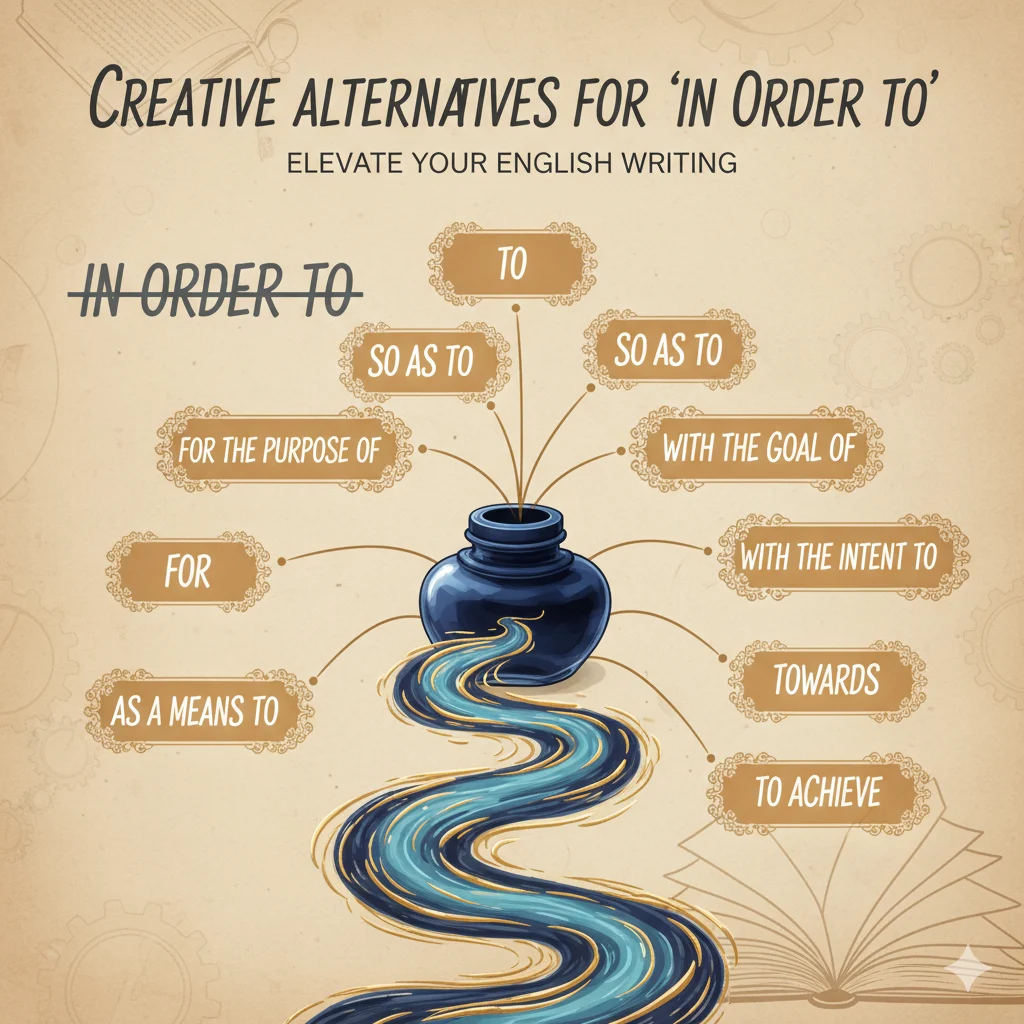
If you’ve ever written an essay, a work email, or even a blog post, chances are you’ve used the phrase “in order to” — a lot.
When I was editing my first research paper, my professor circled that phrase several times in red ink and wrote one short note: “Simplify.”
That moment changed how I viewed writing. I realized that good writing isn’t about sounding complex — it’s about being clear and direct.
While “in order to” isn’t wrong, it’s often longer than necessary. Finding another way to say “in order to” helps your writing sound smoother, more natural, and professional.
Let’s explore creative, academic, and casual alternatives from around the world of English expression.
🧾 Table: Alternatives for “In Order To” and How to Use Them
| Alternative Phrase | Meaning/Usage | Example Sentence |
|---|---|---|
| To | Simplest replacement; direct and clean. | She studies hard to pass her exams. |
| So that | Shows purpose or intention. | He whispered so that no one else could hear. |
| For the purpose of | Formal tone; used in essays. | The policy was implemented for the purpose of improving safety. |
| With the aim of | Suggests goal or objective. | The project was launched with the aim of reducing waste. |
| So as to | Slightly formal; used in business writing. | She left early so as to catch the train. |
| To be able to | Indicates ability or capacity. | He trained hard to be able to run a marathon. |
| With the intention of | Expresses deliberate intent. | They met with the intention of starting a partnership. |
| For the sake of | Shows motivation or reason. | She worked overtime for the sake of her team. |
| In an effort to | Suggests attempt or initiative. | The government took measures in an effort to control inflation. |
| As a means to | Emphasizes method or process. | Reading daily is used as a means to improve vocabulary. |
| In hopes of | Indicates desire or expectation. | He called her in hopes of reconciling. |
| With a view to | British usage; formal and forward-looking. | The reforms were proposed with a view to strengthening the economy. |
| To achieve | Focuses on result or outcome. | She studied marketing to achieve her career goals. |
| So one can | Conversational alternative. | Save your work often so you can avoid losing progress. |
| In pursuit of | Poetic or literary tone. | He traveled the world in pursuit of happiness. |
🧠 Understanding the Phrase “In Order To”
The phrase “in order to” expresses purpose — why something is done.
Example:
She turned off her phone in order to focus on studying.
While grammatically correct, it can often be replaced with simply “to” without changing the meaning:
She turned off her phone to focus on studying.
✍️ When to Keep It
Use “in order to” when:
- You want to emphasize purpose clearly.
- The sentence might sound awkward or confusing without it.
- You’re writing in formal, academic, or legal contexts.
⚡ When to Replace It
Use alternatives when:
- You’re aiming for conciseness or natural tone.
- The sentence already feels long or repetitive.
- You’re writing creative content, blogs, or everyday communication.
🌎 Different Writing Contexts & Cultural Insights
🇺🇸 American English (Clarity and Directness)
In American English, writers often prefer shorter forms like “to” or “so that” because brevity equals clarity.
Example: “He paused to think.”
🇬🇧 British English (Elegance and Formality)
British English sometimes favors formal alternatives such as “with a view to” or “so as to.”
Example: “He resigned with a view to pursuing a new career.”
🎓 Academic Writing (Precision)
In research papers or formal essays, phrases like “for the purpose of” or “with the aim of” help demonstrate careful reasoning.
Example: “The study was conducted for the purpose of assessing market behavior.”
💬 Business & Professional Writing (Polished and Intentional)
Professionals often use “in an effort to” or “with the intention of” to sound purposeful and strategic.
Example: “The company expanded operations in an effort to reach new markets.”
✍️ Creative Writing (Tone and Style)
Writers sometimes choose expressions like “in pursuit of” or “for the sake of” to add emotional depth.
Example: “She fought tirelessly in pursuit of her dreams.”
🕰️ Evolution of “In Order To”
The phrase “in order to” dates back to the 14th century, originating from Latin structures meaning “for the arrangement of.”
Over time, English evolved — preferring simpler forms. In modern communication, clarity and rhythm matter more than length. This evolution shows how language mirrors social changes: from formal and hierarchical to efficient and conversational.
🌸 Proverbs About Clarity and Purpose
- English: “Brevity is the soul of wit.” — Shakespeare
- French: “Ce qui se conçoit bien s’énonce clairement.” — “What is well thought out is clearly stated.”
- Turkish: “Az söz, çok iş.” — “Few words, much work.”
- Japanese: “言葉少なきは、徳なり。” — “Few words show virtue.”
- Arabic: “The best speech is short and full of meaning.”
Across cultures, wisdom teaches that clear expression leads to stronger impact.
❓ FAQs
Q1: What’s the simplest way to replace “in order to”?
Use “to.” It’s short, direct, and fits in nearly every context.
Q2: Is it wrong to use “in order to”?
No, it’s grammatically correct. It just sounds formal or wordy in casual writing.
Q3: What are professional alternatives for “in order to”?
Try “so as to,” “for the purpose of,” or “with the intention of.”
Q4: What’s the difference between “to” and “in order to”?
They often mean the same thing, but “in order to” adds emphasis on purpose or clarity in complex sentences.
Q5: Which version should I use in essays?
For academic writing, prefer “in order to” when you need formality, and “to” when you want conciseness.
❤️ Conclusion: Write With Purpose, Not Length
Choosing another way to say “in order to” isn’t just about vocabulary — it’s about style and clarity.
The best writers know that every word must earn its place. Whether you’re drafting an essay, sending an email, or writing poetry, remember:
“Simplicity is sophistication.”
So next time you type “in order to,” pause and ask — is there a better way to say this?
Chances are, there is.
💬 Now it’s your turn!
Share your favorite alternative for “in order to” in the comments — let’s build a list of smarter, stronger ways to write with clarity.